Running
What is a good VO2 max? Values by age and sex

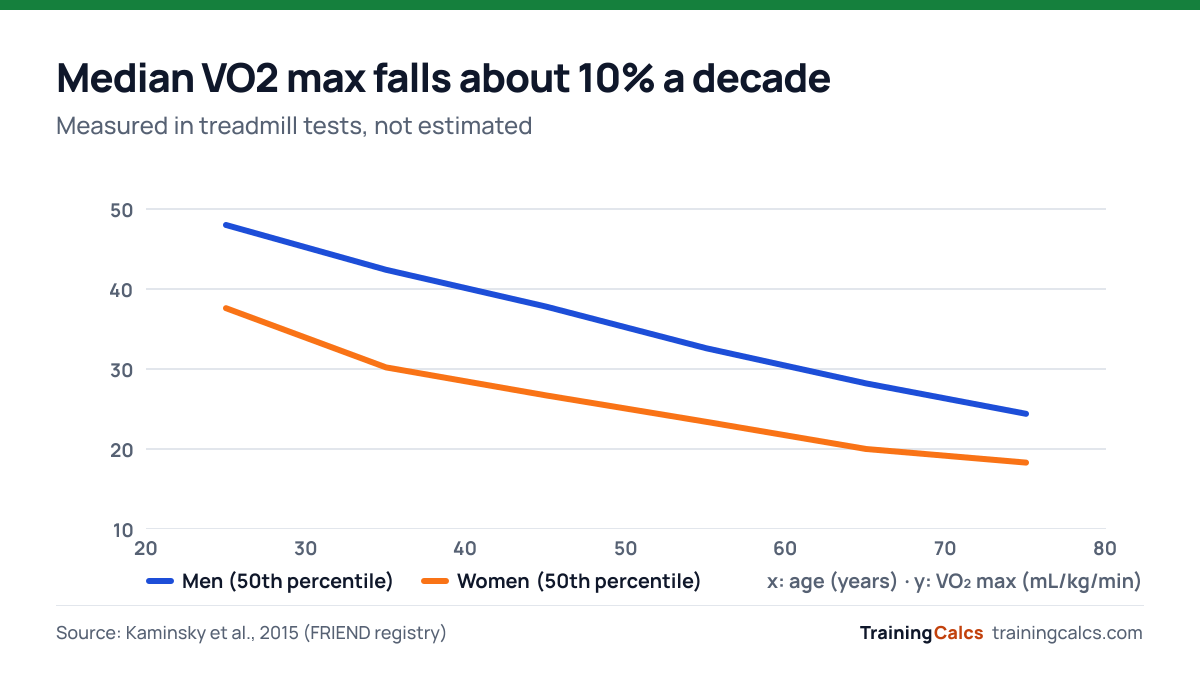
Most answers to this question come from tables whose origin nobody can name. This one uses the FRIEND registry (Kaminsky et al., 2015): the first reference standards for cardiorespiratory fitness in the United States built from measured treadmill tests rather than estimates from workload.
The short answer
A good VO2 max is one above the median for your age and sex. For a man in his twenties that median is 48.0 mL/kg/min; for a woman in her twenties, 37.6. Both fall by roughly 10% per decade from there.
That is the answer most people want. The more useful answer is in the second half of this page, because a single number compared against a median hides how wide the normal range actually is.
Median VO2 max by age and sex
These are 50th-percentile values from measured cardiopulmonary exercise tests, in mL/kg/min.
| Age group | Men | Women |
|---|---|---|
| 20–29 | 48.0 | 37.6 |
| 30–39 | 42.4 | 30.2 |
| 40–49 | 37.8 | 26.7 |
| 50–59 | 32.6 | 23.4 |
| 60–69 | 28.2 | 20.0 |
| 70–79 | 24.4 | 18.3 |
The full percentile tables — 5th through 95th for every decade — are on the VO2 max calculator, which also places your own figure against them.
Why the spread matters more than the median
Here is the thing the medians hide. Take men aged 40–49: the median is 37.8, but the group runs from 24.2 at the 5th percentile to 55.6 at the 95th.
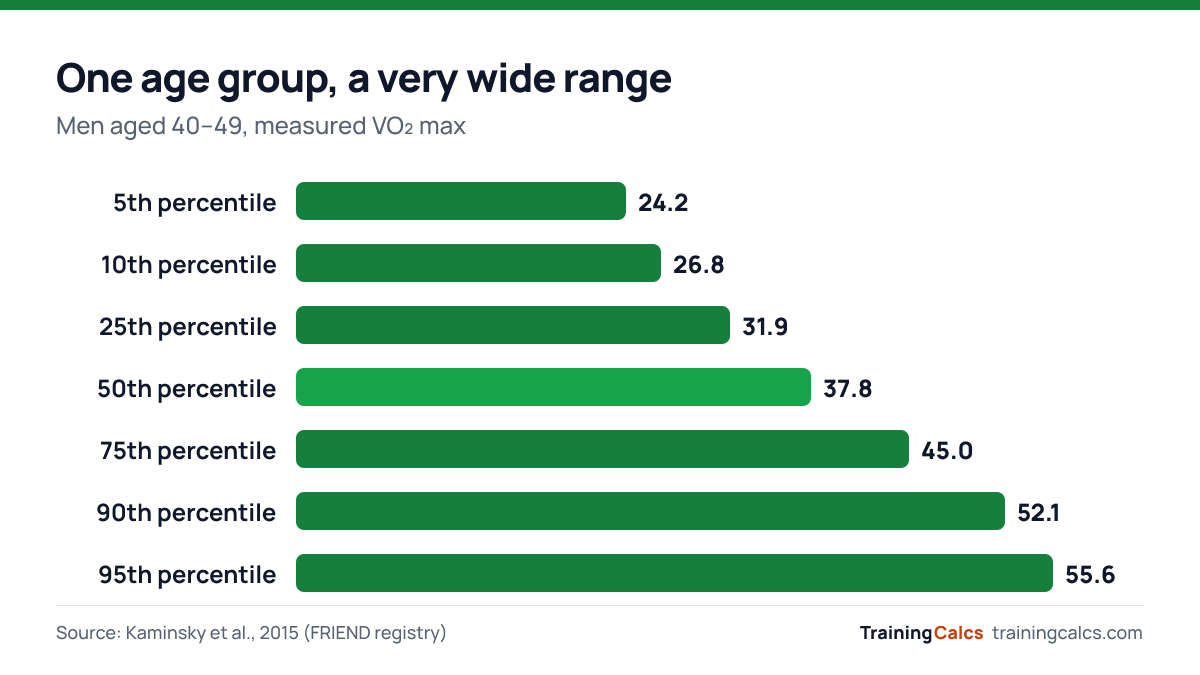
That is a range of over 31 points inside a single decade. The gap between the median for men in their twenties (48.0) and men in their forties (37.8) is about ten points. In other words, the difference between a fit and an unfit forty-year-old is three times the difference that twenty years of ageing makes.
This is why “good for my age” is a weak frame. Age sets the row you read; it does not determine where in that row you land.
Estimating yours
Short of a laboratory, the Cooper 12-minute run is the best-known field test. Run as far as you can in twelve minutes on a flat, measured course:
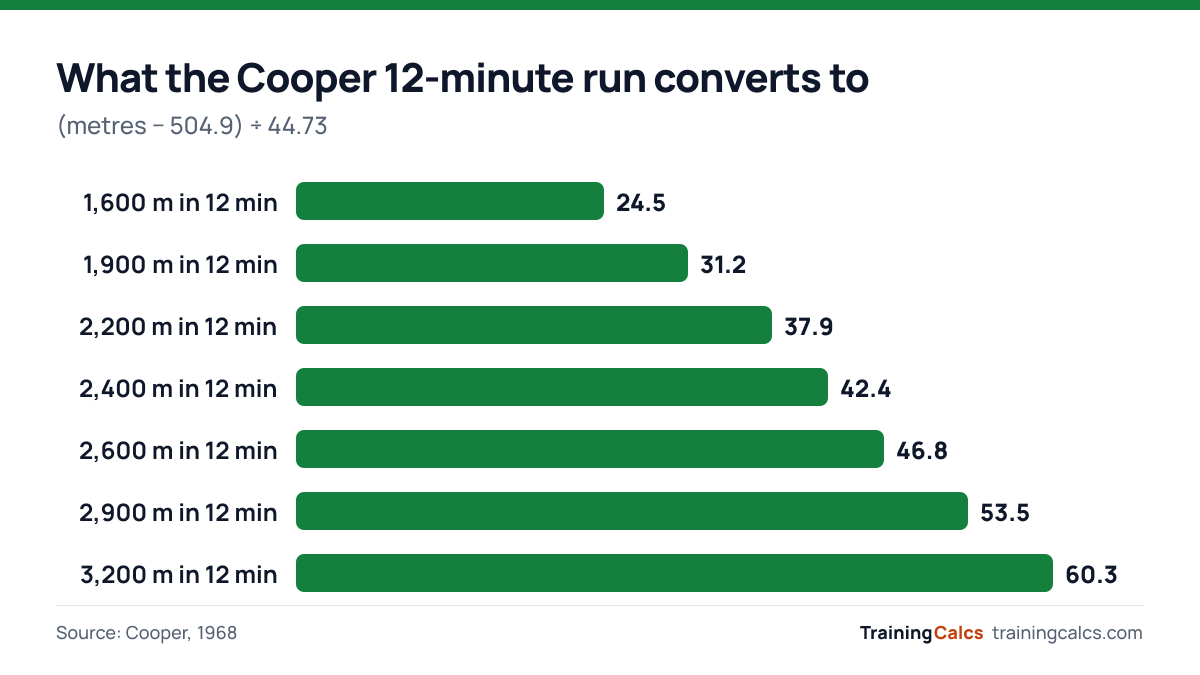
Every extra 100 m is worth about 2.2 points, which is also the warning: pacing the test badly costs you more than a bad day of fitness would. Starting too fast and fading at eight minutes can easily cost 200 m, and with it four points.
If an all-out twelve minutes is not available, the heart rate ratio method estimates VO2 max as PF × (HRmax ÷ HRrest), where the proportionality factor is 15.3 for men (Uth et al., 2004) and 14.5 for women (Uth, 2005) — using one figure for everyone overestimates a woman’s result by about 5%. It needs a real maximum heart rate from a hard effort — the 220-minus-age rule is a population average with a wide spread, and feeding it in makes the result meaningless.
What the decline with age really means
The 10% per decade in this data is a population average across people in every training state, measured at one point in time. It is not a schedule your own body is following, and it is not a ceiling. An untrained person who starts training in their forties moves up the percentiles within their own age group, which is the comparison that actually describes their fitness.
What VO2 max does not tell you
It sets a ceiling on endurance performance; it does not predict performance. Two runners with the same VO2 max can race very differently, because what they do with that ceiling — the fraction of it they can hold for an hour, and how economically they run — varies a lot between people.
There is also the measurement gap. A field estimate and a treadmill test with a mask are different quantities, and a sports watch is a third thing again: each manufacturer uses its own undisclosed model from speed and heart rate. All three are useful for tracking your own trend over months. None of them is reliable enough to argue about a single number.
If you want a figure that predicts race day, a recent race is better. The marathon pace calculator turns a goal into splits, and the grade-adjusted pace calculator lets you compare efforts across different terrain.
Try the VO2 Max CalculatorEstimate your VO2 max and see where it lands against measured reference values.Frequently asked questions
What is a good VO2 max by age?
Against measured reference values, the median for men aged 20–29 is 48.0 mL/kg/min and for women 37.6. By 40–49 those medians are 37.8 and 26.7, and by 60–69 they are 28.2 and 20.0. Beating the median for your own age and sex is a reasonable definition of good.
Is a VO2 max of 50 good?
It depends entirely on who you are. For a man in his twenties, 50 sits a little above the median of 48.0. For a woman in her twenties it is close to the 90th percentile, and for a man in his sixties it is above the 95th. The same number is unremarkable or exceptional depending on the row you read it against.
What is a good VO2 max for a runner?
Competitive distance runners typically measure well above the general-population percentiles here, because the reference data covers everyone who had a clinical exercise test, not athletes. For a runner the more useful question is whether your own figure is rising, and whether your race times are following it.
How do I find out my VO2 max without a lab?
Two field methods with published equations: the Cooper 12-minute run, where VO2 max = (metres − 504.9) ÷ 44.73, and the heart rate ratio method, where VO2 max ≈ PF × (HRmax ÷ HRrest) — the factor being 15.3 for men and 14.5 for women. Both are estimates with real error bars, and both need a genuine maximal effort to mean anything.
Can you improve VO2 max after 40?
Yes. The roughly 10% per decade decline in the reference data is a population average across people of all training states, not a limit on what an individual can do. Someone untrained at 45 who starts consistent endurance training moves up the percentiles for their age group, which is the comparison that matters.
References
- Kaminsky LA, Arena R, Myers J. Reference standards for cardiorespiratory fitness measured with cardiopulmonary exercise testing: data from the Fitness Registry and the Importance of Exercise National Database (FRIEND). Mayo Clin Proc. 2015;90(11):1515–1523. pubmed.ncbi.nlm.nih.gov/26455884/
- Cooper KH. A means of assessing maximal oxygen intake: correlation between field and treadmill testing. JAMA. 1968;203(3):201–204. pubmed.ncbi.nlm.nih.gov/5694044/
- Uth N, Sørensen H, Overgaard K, Pedersen PK. Estimation of VO2max from the ratio between HRmax and HRrest — the Heart Rate Ratio Method. Eur J Appl Physiol. 2004;91(1):111–115. pubmed.ncbi.nlm.nih.gov/14624296/
General fitness information, not medical advice. Figures are estimates calculated with the formulas cited above. Check with a doctor or qualified coach before major changes to diet, supplements or training. Read the full medical disclaimer and how we write and check these pages in our editorial policy.