Running
What is a good marathon pace? Chart and finish times
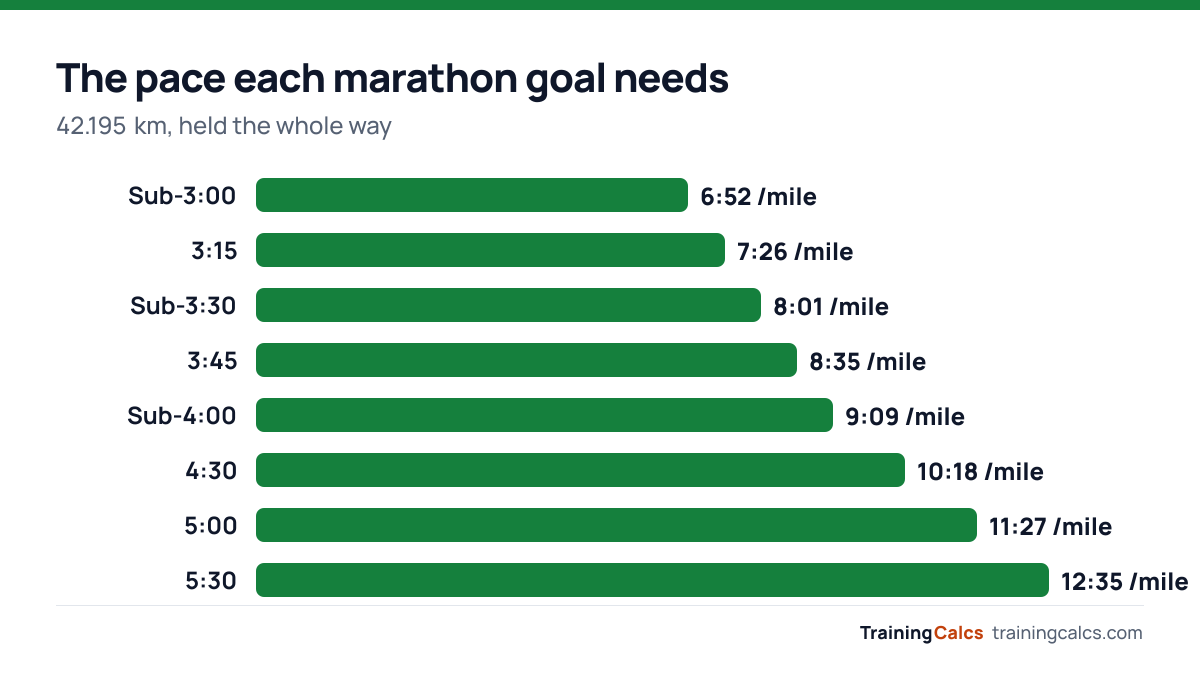
“Good” is doing a lot of work in that question, and most answers dodge it with a table of finish times. Here is the table — but the more useful answer is that a good marathon pace is one you can still be running at 35 km, and the research on how real marathoners pace themselves says that is rarer than you would think.
What counts as a good marathon pace
There is no universal number, and anyone giving you one is selling something. What there are, are three honest reference points:
- Your own previous races. The only comparison that controls for your age, training history, build and life. A pace that is good for you is one that beats your last attempt on a similar course.
- Whether you held it. A 3:45 run as 1:48 / 1:57 is a worse race than a 3:50 run as 1:55 / 1:55, whatever the finish clock says. The second runner raced; the first one faded.
- What your recent shorter races predict. A half marathon from the last six weeks is a far better guide than a number you picked because it sounds good.
Marathon pace chart
Every goal time is the distance — 42.195 km, fixed by World Athletics — divided into the time you want. Halfway is simply half of it, if you pace evenly.
| Goal time | Per mile | Per km | Halfway |
|---|---|---|---|
| 2:45:00 | 6:18 | 3:55 | 1:22:30 |
| 3:00:00 | 6:52 | 4:16 | 1:30:00 |
| 3:15:00 | 7:26 | 4:37 | 1:37:30 |
| 3:30:00 | 8:01 | 4:59 | 1:45:00 |
| 3:45:00 | 8:35 | 5:20 | 1:52:30 |
| 4:00:00 | 9:09 | 5:41 | 2:00:00 |
| 4:15:00 | 9:44 | 6:03 | 2:07:30 |
| 4:30:00 | 10:18 | 6:24 | 2:15:00 |
| 4:45:00 | 10:52 | 6:45 | 2:22:30 |
| 5:00:00 | 11:27 | 7:07 | 2:30:00 |
| 5:15:00 | 12:01 | 7:28 | 2:37:30 |
| 5:30:00 | 12:35 | 7:49 | 2:45:00 |
| 5:45:00 | 13:10 | 8:11 | 2:52:30 |
| 6:00:00 | 13:44 | 8:32 | 3:00:00 |
Why even pacing beats a fast start
Santos-Lozano and colleagues took every New York City Marathon finish from 2006 to 2011 — 190,228 runners — and looked at the 5 km splits. The headline finding is bleak and useful: every group of runners, from the front to the back of the field, ran a positive split. Everybody slows down.
What separated them was how much. Across 5 km splits the fastest runners varied their speed by 6.6% (women) to 7.8% (men). The slowest varied by up to 14.4% — about twice the drift over the same course. The authors are explicit about the cause: an excessively fast start is what produces a pronounced decrease in speed in the second half.
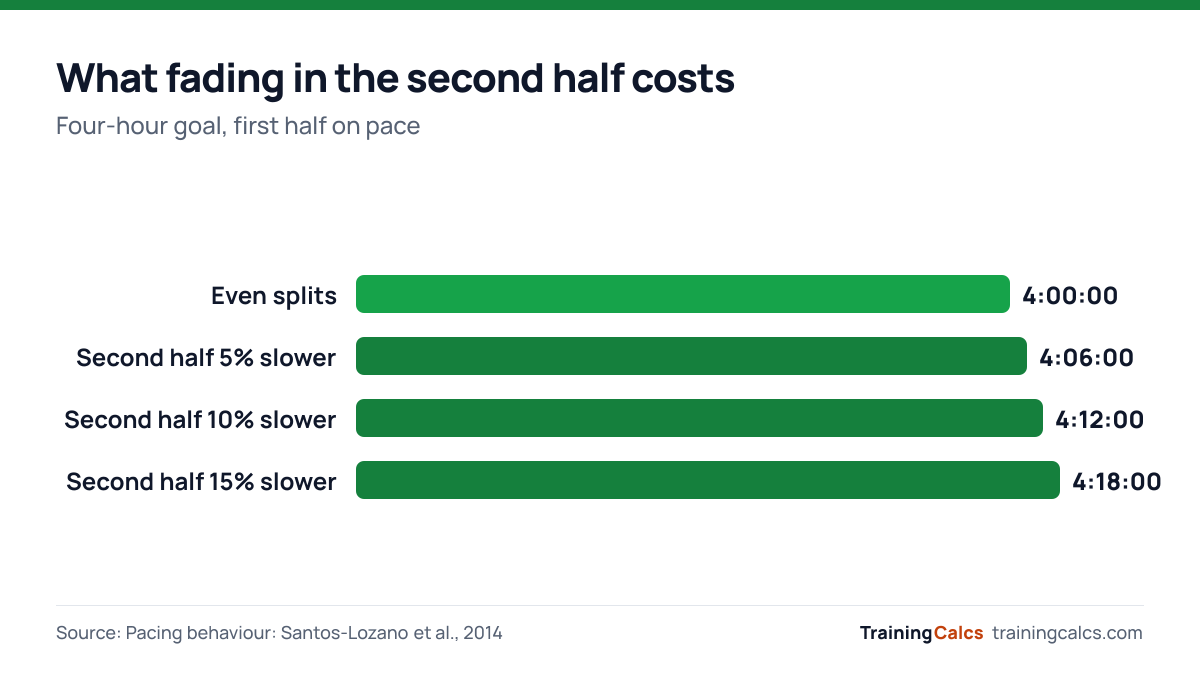
The arithmetic is unforgiving. Run the first half of a four-hour marathon exactly on pace, then fade 10% in the second, and you finish at 4:12 — twelve minutes lost, having done the first 21 km perfectly. At 15% it is 4:18.
What ten seconds a mile is worth
Marathon pacing errors are quiet. Ten seconds per mile is nothing you can feel, and no watch beeps at you about it. Over 26.2 miles it is 4:22.
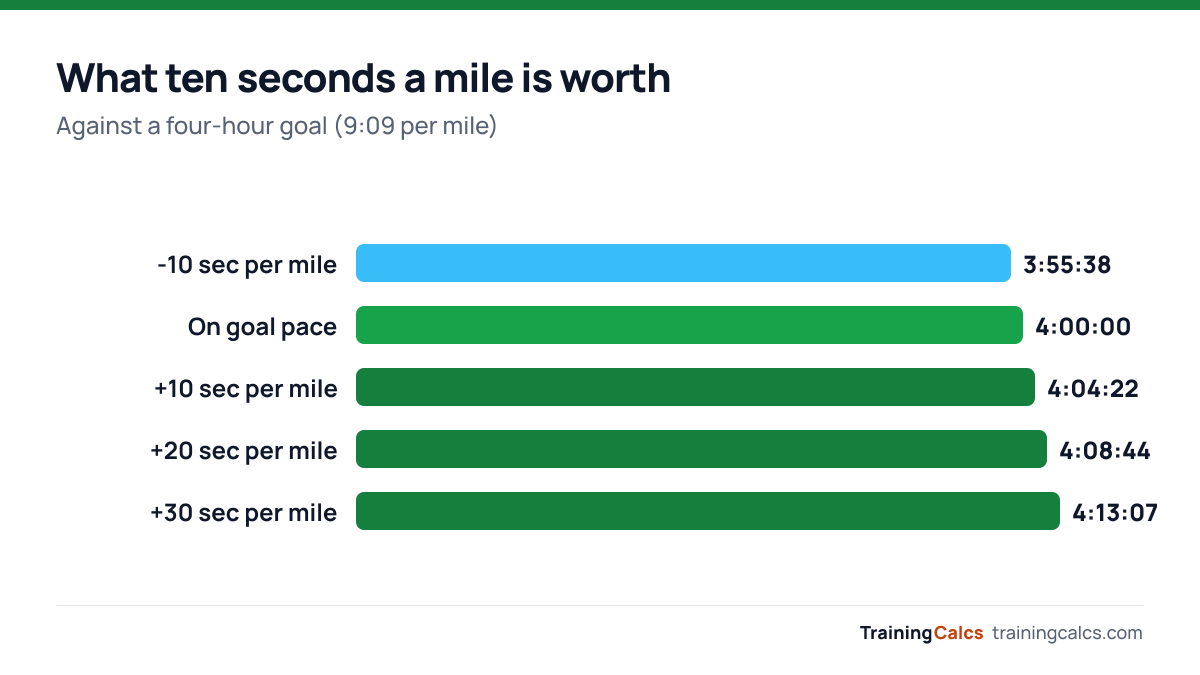
This cuts both ways, and the left-hand bar is the point: being ten seconds a mile faster than goal for the first half does not bank 4:22 of cushion. It spends energy you need at 32 km, and the research above says you give it back with interest.
Choosing a goal you can hold
Work backwards from evidence rather than forwards from ambition. A recent half marathon is the best single predictor most runners have: double it and add 10–20 minutes, with the larger end of that range if your longest run has been under 30 km or the course is hilly.
Then rehearse it. Run two or three long runs with a block at goal pace in the back half — not the front — so you find out what it feels like on tired legs, which is the only place it matters. If goal pace falls apart at 28 km in training, it will not hold at 35 km on race day.
What a pace chart cannot know
The chart assumes flat ground, still air and constant effort. Real courses have none of those. On hills, holding pace means varying effort, which is the wrong thing to hold steady — the grade-adjusted pace calculator shows what each gradient actually costs. Heat is worse and less forgiving: on a warm day, insisting on goal pace through halfway is a common way for a race to end rather than go well.
And if your plan includes walk breaks — a reasonable choice for a first marathon — the average pace they produce is rarely what people expect. The run-walk calculator works it out properly: paces cannot simply be averaged.
Try the Marathon Pace CalculatorThe pace and splits your goal marathon time actually needs.Frequently asked questions
What is a good marathon pace for a beginner?
For a first marathon, the pace you can hold for the whole distance is better than any target from a table. Most first-timers are well served by a pace that feels conversational for the first 10 km, which usually lands between 10:00 and 12:00 per mile. Finishing without walking the last 10 km is a better first goal than a time.
What pace is a 4-hour marathon?
9:09 per mile, or 5:41 per kilometre, held for the full 42.195 km. Halfway should come up at 2:00:00. A 3:30 needs 8:01 per mile and a 3:00 needs 6:52.
Should I bank time early in a marathon?
No. Santos-Lozano et al. (2014) found an excessively fast start is what produces a pronounced slowdown in the second half. The time you gain in the first 10 km comes back with interest after 30 km, and the interest rate over a marathon is steep.
Is it normal to slow down in a marathon?
It is close to universal. Across 190,228 New York finishes, every performance group ran a positive split. What separated the fastest runners was consistency: they varied their 5 km speed by 6.6–7.8%, while the slowest varied by up to 14.4%.
How do I work out my marathon pace?
Divide your goal time by the distance: 42.195 for a pace per kilometre, or 26.219 for a pace per mile. The marathon pace calculator does it both ways and prints the 5K and mile splits.
References
- Santos-Lozano A, Collado PS, Foster C, Lucia A, Garatachea N. Influence of sex and level on marathon pacing strategy: insights from the New York City race. Int J Sports Med. 2014;35(11):933–938. pubmed.ncbi.nlm.nih.gov/24886929/
- World Athletics. Technical information and competition rules — standard road race distances, including the marathon at 42.195 km. worldathletics.org/about-iaaf/documents/technical-information
General fitness information, not medical advice. Figures are estimates calculated with the formulas cited above. Check with a doctor or qualified coach before major changes to diet, supplements or training. Read the full medical disclaimer and how we write and check these pages in our editorial policy.