Running
Treadmill vs outdoor running: what the research says

Every runner has an opinion on this and most of them are vibes. There is actually a decent evidence base: a 2019 meta-analysis pooled 34 crossover studies that put the same runners on a treadmill and on the ground, and a 2020 review did the same for biomechanics. The answers are more interesting than “the treadmill is easier”.
Is the treadmill actually easier?
By oxygen cost, almost not at all. Miller and colleagues (2019) found submaximal oxygen uptake on a motorised treadmill was close to overground running at both 0% and 1% grade — mean differences of about half a millilitre per kilogram per minute, in both directions. Blood lactate was consistently a little lower on the treadmill. At maximal effort, oxygen uptake and heart rate were similar.
So the belt is not doing your running for you. What it removes is air resistance, hills, wind and uneven ground — real things, but a smaller share of the cost than most people assume. What it does not remove is the work of supporting your body weight and swinging your legs, which is most of what running costs.
Where the 1% rule comes from
Setting the treadmill to 1% is one of the most repeated pieces of advice in running, and almost nobody who repeats it names the source. It is Jones and Doust (1996): they measured the oxygen cost of treadmill running at several gradients and compared it with running outdoors at the same speeds, and 1% was where the two matched.
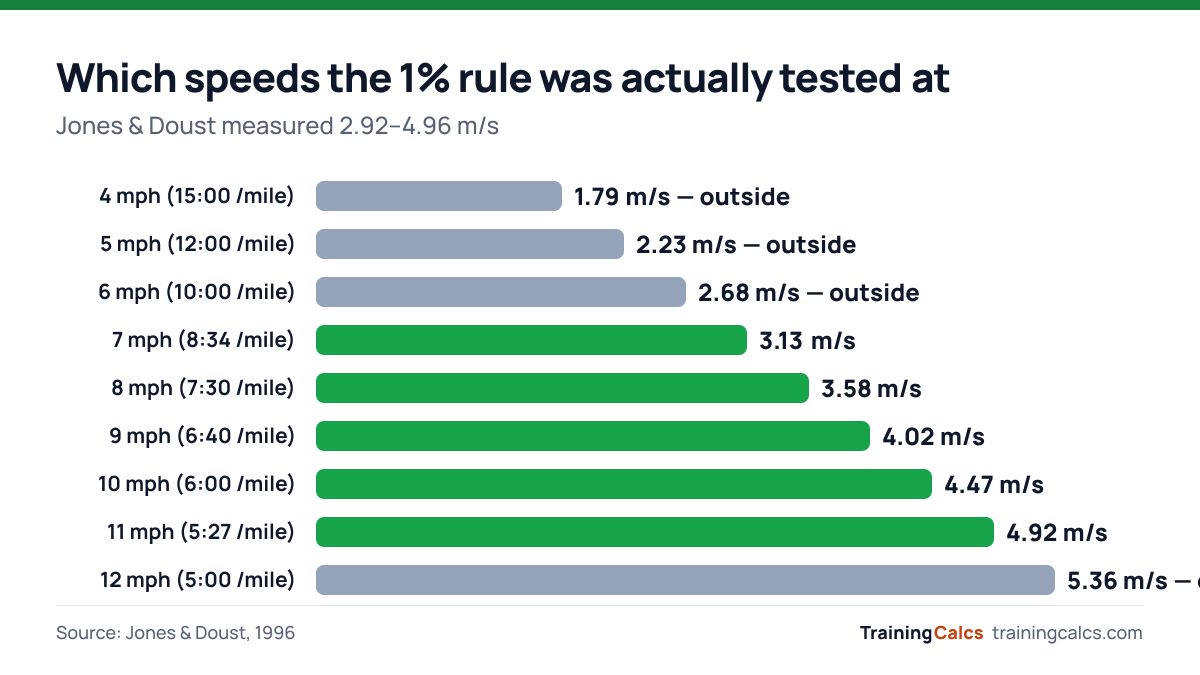
Two things usually get left out. The first is the speed range — their runners were moving at 2.92 to 4.96 m/s, which is about 7 to 11 mph, or 8:35 to 5:25 per mile. Outside that band the 1% figure is an extrapolation.
The second is that the later meta-analysis found oxygen cost was already close to overground at 0% grade. That does not make 1% wrong — it is a sensible, harmless convention — but the evidence behind it is one study at particular speeds, not a settled law. If you walk or jog slowly, 0% is closer to honest.
Why it still feels harder
Here is the finding that matches what runners actually report: endurance performance was poorer on a treadmill than overground in the pooled studies, even where the oxygen cost matched. Perceived effort and heart rate ran higher at faster submaximal speeds, and lower at slower ones.
In other words, the treadmill asks about the same of your aerobic system and more of everything else. The usual suspects: no moving air to carry heat away, so you cook slowly after twenty minutes; a fixed speed you cannot drift from; and nothing to look at. If an easy run feels disproportionately hard indoors, you are not imagining it and you are not unfit.
Does it change your stride?
Van Hooren and colleagues (2020) reviewed treadmill versus overground biomechanics across the literature. The short version is that some kinematic and kinetic variables differ and many of the differences are small. It is a reasonable substitute rather than an identical one — which is roughly what you would expect from a surface that is flat, consistent and slightly compliant.
What is not true is the belt-pulls-your-legs-through story. It gets repeated because the belt visibly moves, but your legs still swing and your weight is still supported on every stride.
Converting speed to pace
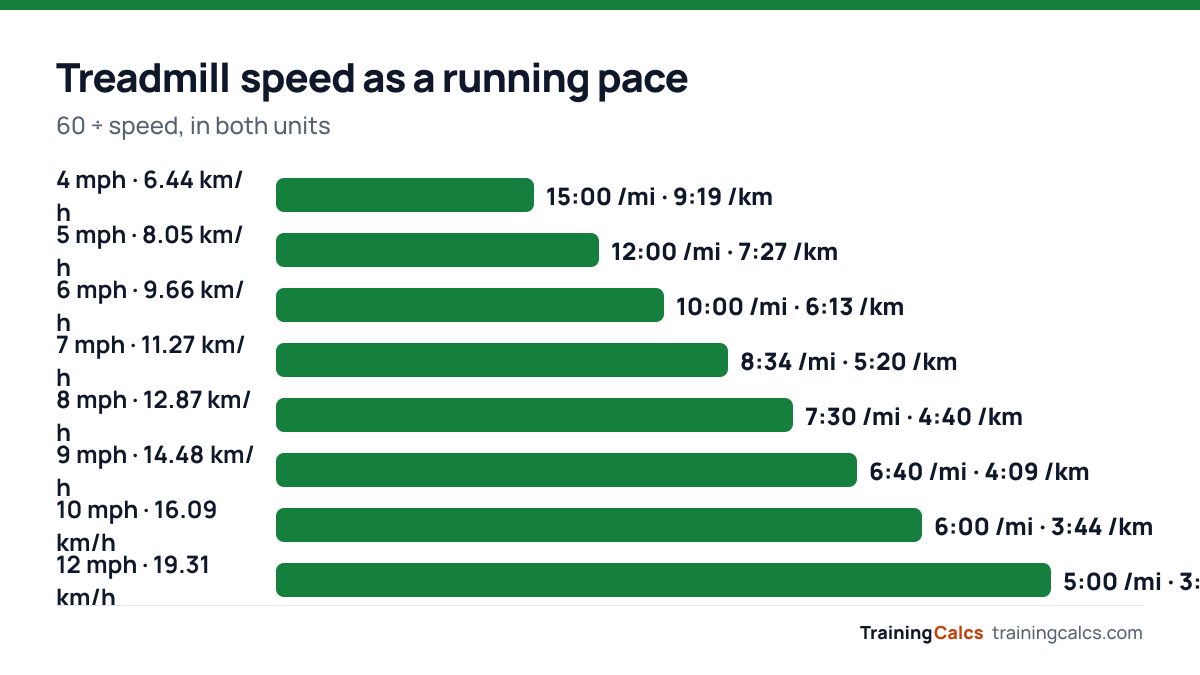
The console gives you speed; your training plan is written in pace. One division connects them:
Minutes per mile = 60 ÷ mph · Minutes per km = 60 ÷ km/h
| Speed | km/h | Per mile | Per km | In the 1% study's range |
|---|---|---|---|---|
| 4 mph | 6.44 km/h | 15:00 | 9:19 | No |
| 5 mph | 8.05 km/h | 12:00 | 7:27 | No |
| 6 mph | 9.66 km/h | 10:00 | 6:13 | No |
| 7 mph | 11.27 km/h | 8:34 | 5:20 | Yes |
| 8 mph | 12.87 km/h | 7:30 | 4:40 | Yes |
| 9 mph | 14.48 km/h | 6:40 | 4:09 | Yes |
| 10 mph | 16.09 km/h | 6:00 | 3:44 | Yes |
| 11 mph | 17.7 km/h | 5:27 | 3:23 | Yes |
| 12 mph | 19.31 km/h | 5:00 | 3:06 | No |
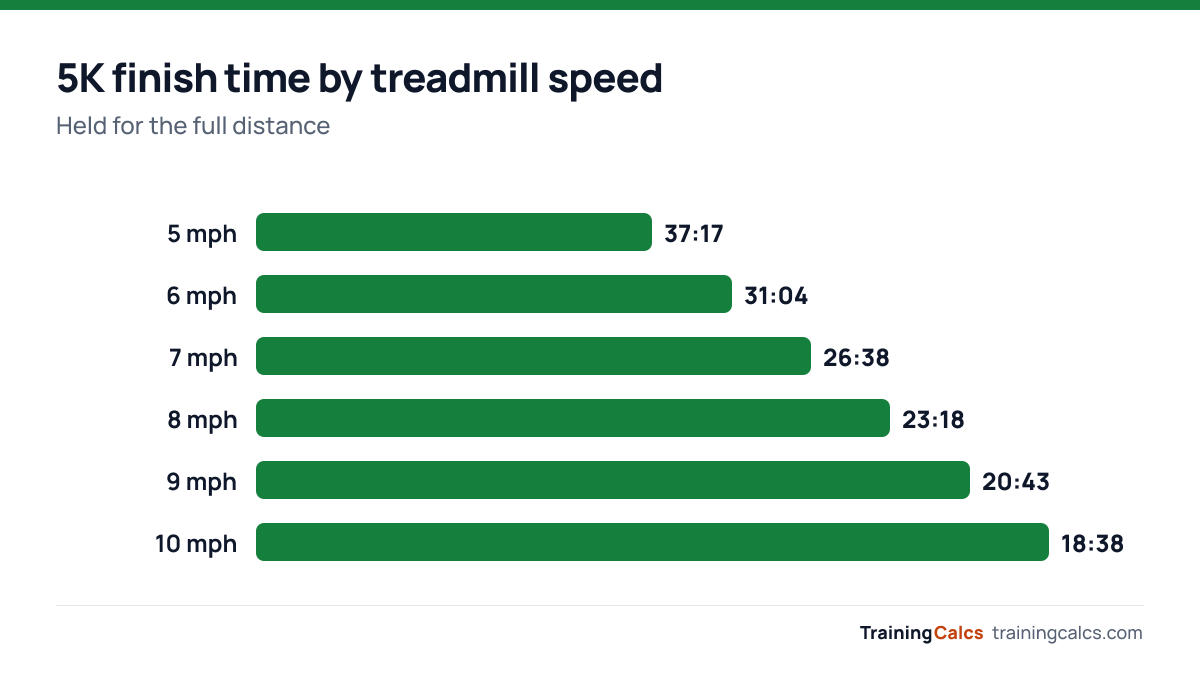
The treadmill pace calculator does this both ways and tells you whether your speed falls inside the band the 1% finding was measured over.
When the treadmill is the right choice
On the evidence above, the treadmill is a good substitute and a poor race simulator. It suits sessions where holding an exact speed is the point — steady efforts, controlled intervals, progression runs — and days when ice, darkness or air quality make the alternative worse than the compromise.
It suits race-specific work less well, because the thing you are rehearsing includes wind, camber, gradient and the self-pacing that a belt takes away from you. If a hilly race is the goal, the grade-adjusted pace calculator is the better tool for working out what the terrain will cost, and that is not a number a flat belt can teach you.
Try the Treadmill Pace CalculatorTurn the number on the treadmill display into your pace per mile and per kilometre.Frequently asked questions
Is running on a treadmill easier than outside?
Physiologically, barely. A meta-analysis of 34 crossover studies found oxygen cost during submaximal running was close to overground at both 0% and 1% grade, with mean differences under about 0.6 mL/kg/min. Blood lactate was lower on the treadmill. What the belt removes is air resistance, terrain and gradient — not the work of supporting and swinging your legs.
Should I run at 1% incline on a treadmill?
It is a reasonable default and it will not hurt. Just know it is thinner evidence than it sounds: it comes from a single 1996 study at speeds between 2.92 and 4.96 m/s, and the later meta-analysis found oxygen cost was already close to overground at 0%.
Why is running on a treadmill so much harder mentally?
The research backs the feeling, not just the complaint. Endurance performance in the meta-analysis was poorer on treadmills than overground. Perceived effort also ran higher at faster speeds. No moving air to carry heat away, no changing scenery and no terrain variation all plausibly contribute.
Does the treadmill pull your legs through for you?
No. This is the most repeated myth about treadmill running. The belt moves under you, but your legs still have to swing through and your body mass still has to be supported and propelled on each stride. What you save is pushing through still air.
Is treadmill running bad for your running form?
A systematic review of treadmill versus overground biomechanics found some differences in joint kinematics and kinetics, though many were small. For most runners the practical answer is that treadmill running is a reasonable substitute, not an identical one.
References
- Miller JR, Van Hooren B, Bishop C, Buckley JD, Willy RW, Fuller JT. A systematic review and meta-analysis of crossover studies comparing physiological, perceptual and performance measures between treadmill and overground running. Sports Med. 2019;49(5):763–782. pubmed.ncbi.nlm.nih.gov/30847825/
- Jones AM, Doust JH. A 1% treadmill grade most accurately reflects the energetic cost of outdoor running. J Sports Sci. 1996;14(4):321–327. pubmed.ncbi.nlm.nih.gov/8887211/
- Van Hooren B, Fuller JT, Buckley JD, Miller JR, Sewell K, et al. Is motorized treadmill running biomechanically comparable to overground running? A systematic review and meta-analysis. Sports Med. 2020;50(4):785–813. pubmed.ncbi.nlm.nih.gov/31802395/
General fitness information, not medical advice. Figures are estimates calculated with the formulas cited above. Check with a doctor or qualified coach before major changes to diet, supplements or training. Read the full medical disclaimer and how we write and check these pages in our editorial policy.