Running
Run walk ratio: which interval should you use?

Most advice on run-walk ratios is prescriptive — use 4:1, use 30/30 — and skips the part that would let you choose for yourself: what each ratio actually does to your average pace, and what the evidence says the breaks cost. Both are more interesting than the prescriptions.
What a run-walk ratio is
A run-walk ratio alternates a fixed period of running with a fixed walk, repeated from the start of the run to the end. “4:1” means four minutes running, one minute walking. The breaks are planned and taken from the first mile — not taken when you are tired, which is a different thing entirely.
The arithmetic trips people up. You cannot average the two paces: run 4 minutes at 9:00 per mile and walk 1 minute at 15:00, and weighting those paces by time gives 10:12, but your real average is 9:47. Over a marathon that error is eleven minutes. What averages is distance covered, not pace.
What each ratio actually produces
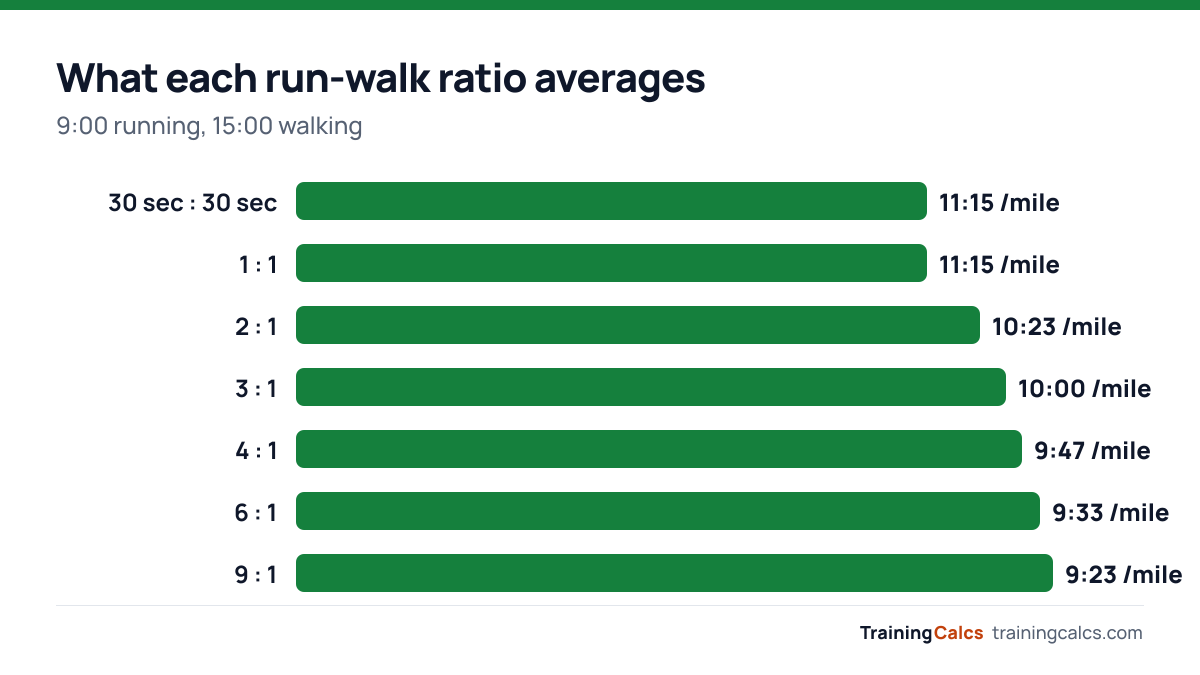
Running at 9:00 per mile and walking at 15:00, for every common ratio:
| Ratio | Time running | Average pace | Half | Marathon | Breaks |
|---|---|---|---|---|---|
| 30 sec : 30 sec | 50% | 11:15 /mile | 2:27:29 | 4:54:58 | 294 |
| 1 : 1 | 50% | 11:15 /mile | 2:27:29 | 4:54:58 | 147 |
| 2 : 1 | 67% | 10:23 /mile | 2:16:08 | 4:32:16 | 90 |
| 3 : 1 | 75% | 10:00 /mile | 2:11:06 | 4:22:11 | 65 |
| 4 : 1 | 80% | 9:47 /mile | 2:08:15 | 4:16:29 | 51 |
| 6 : 1 | 86% | 9:33 /mile | 2:05:08 | 4:10:16 | 35 |
| 9 : 1 | 90% | 9:23 /mile | 2:02:54 | 4:05:48 | 24 |
The returns are not linear. Going from 1:1 to 4:1 buys you far more than going from 4:1 to 9:1 — most of the cost of walking is paid in the first few ratios, which is why 2:1 and 4:1 are such common recommendations.
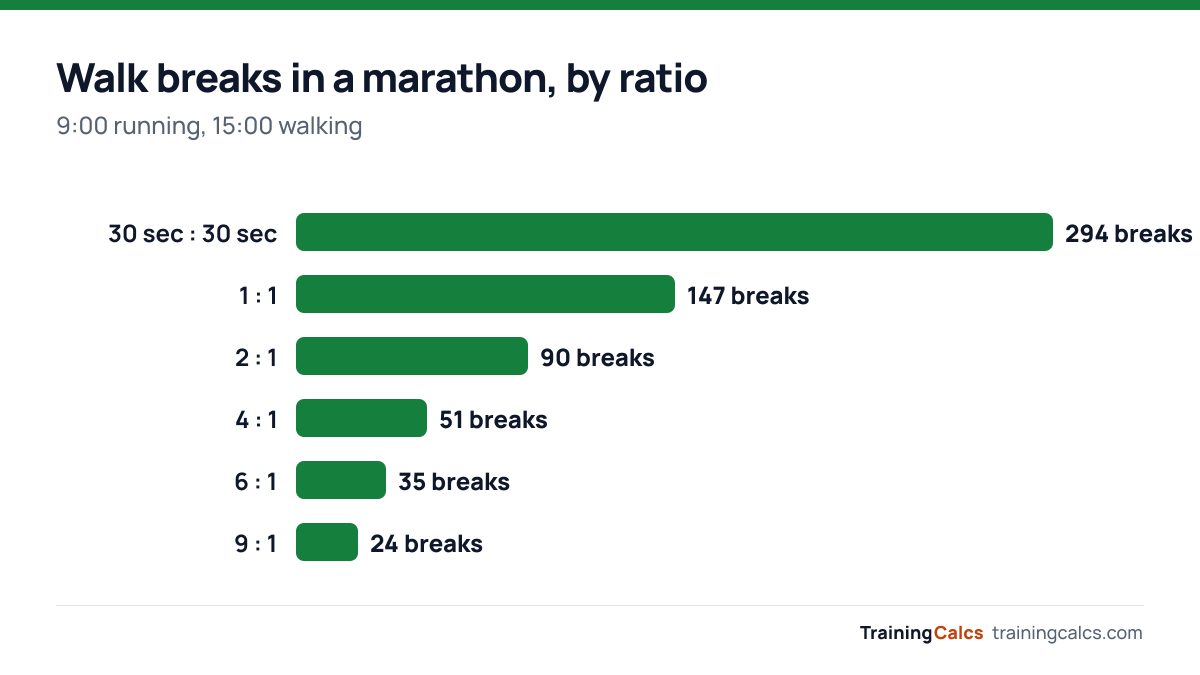
The number of breaks is worth looking at before you commit. At 30 seconds each way a marathon involves 174 transitions. That is not an argument against it — short intervals suit plenty of runners — but it is a lot of starting and stopping to stay on top of.
How hard you walk matters
The ratio gets all the attention and the walk pace gets none, which is backwards. Keep the ratio and the running pace fixed, change only how briskly you walk:
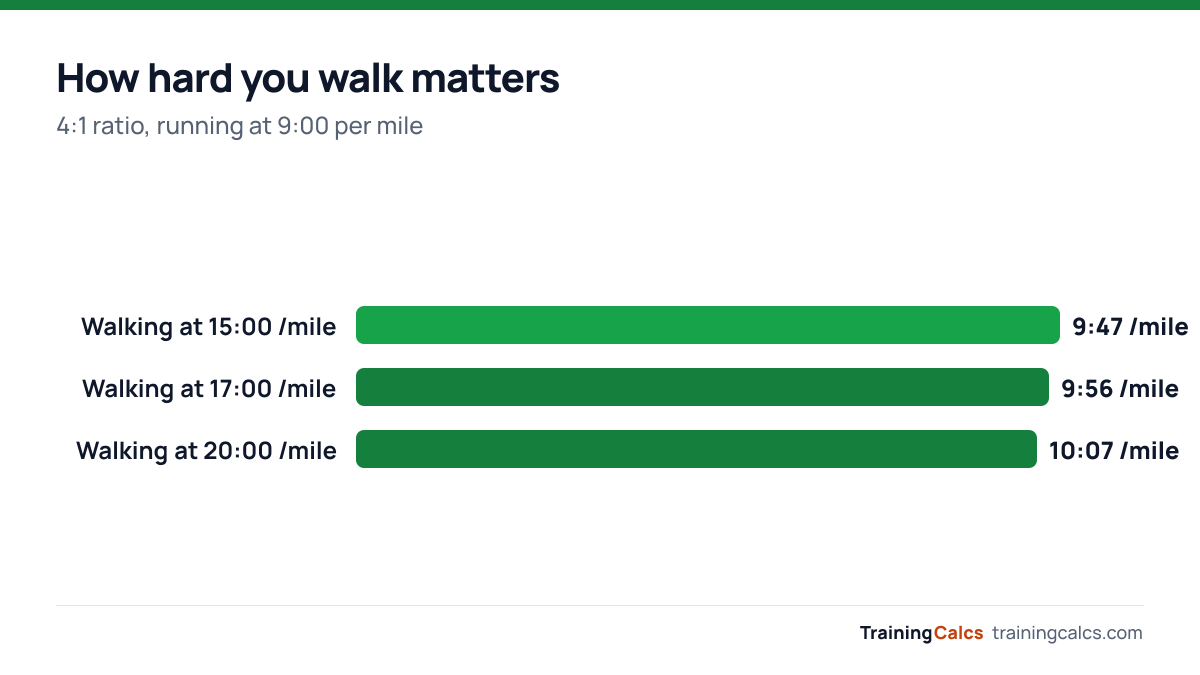
A purposeful 15:00 walk gives 9:47 per mile. An amble at 20:00 gives 10:07 — twenty seconds a mile, or about nine minutes across a marathon, for the same ratio and the same running. Walk breaks are part of the race, not a rest from it.
Choosing your ratio
- Faster runners, shorter breaks. At 7:00 pace a full minute of walking costs more ground than it does at 11:00, so 9:1 and 6:1 suit faster runners while 2:1 and 1:1 suit slower ones and beginners.
- Longer race, more generous breaks. A ratio that feels unnecessary at 10 km is often the reason a marathon holds together.
- Rehearse it. Run your long runs at the ratio you plan to race. The right one is whichever you can still hold at 35 km, and that is not knowable from a table.
Does it cost you time?
This is the question that stops people trying it, and there is a decent answer. Hottenrott and colleagues (2016) randomised 42 non-elite runners across a marathon — half using a run/walk strategy, half running throughout. The run/walk group finished in 4:14:25, the running-only group in 4:07:40. About seven minutes apart, and not statistically significant (p = 0.377) in a group that varied by twenty minutes either way.
What did differ, clearly: the run/walk group reported significantly less muscle pain and fatigue afterwards (p = 0.006). For a runner whose marathon falls apart in the last 10 km, that is the whole case — you are trading a few minutes you may not lose anyway for arriving at 30 km with legs that still work.
What run-walk does not do
The same study measured cardiac biomarkers after the finish and found the run/walk strategy did not reduce the load on the cardiovascular system. Both groups showed the same reversible rise that any marathon produces.
So if you have been told to limit cardiovascular strain, walk breaks are not the adjustment that does it, and that is a conversation for a doctor rather than a calculator.
Making it work on race day
Start the breaks in the first mile, keep them even, and walk them with purpose. Set an interval timer rather than trusting your judgement at 32 km, and position yourself to the side of the road before each break so you are not stopping in front of someone.
For your own paces rather than the 9:00 and 15:00 used here, the run-walk calculator gives the average and the finish times. If the course is hilly — and taking the break on the climbs is a common tactic — the grade-adjusted pace calculator shows what each gradient is costing, which is a reasonable way to decide where the breaks go.
Try the Run-Walk CalculatorSet your run and walk intervals and see the average pace they actually produce.Frequently asked questions
What is the best run walk ratio?
The one you can hold to the end. Faster runners generally take shorter breaks — 9:1 or 6:1 — because a full minute of walking costs more at 7:00 pace than at 11:00. Beginners and slower runners do well on 2:1, 1:1 or 30 seconds each way. Rehearse it on long runs before racing it.
What pace does a 4:1 run walk ratio give?
Running at 9:00 per mile and walking at 15:00, a 4:1 ratio averages 9:47 per mile — a 4:16:29 marathon. Change either pace and the average moves; the run-walk calculator works it out for your own numbers.
Do walk breaks slow you down?
Less than runners expect. Hottenrott et al. (2016) randomised 42 non-elite runners across a marathon: the run/walk group finished in 4:14:25 and the running-only group in 4:07:40, a difference that was not statistically significant across a group varying by twenty minutes either way.
When should I start taking walk breaks in a race?
From the first mile. The method works by saving your legs before they are tired. Walking from mile 20 because you are struggling is not a run-walk strategy — it is the thing a run-walk strategy exists to prevent.
How many walk breaks is that in a marathon?
At 4:1 with those paces, 51. At 30 seconds each way it is 174, and at 9:1 it is 25. Shorter intervals are not wrong, but they are a lot of transitions to manage over 26.2 miles.
References
- Hottenrott K, Ludyga S, Schulze S, Gronwald T, Jäger FS. Does a run/walk strategy decrease cardiac stress during a marathon in non-elite runners? J Sci Med Sport. 2016;19(1):64–68. pubmed.ncbi.nlm.nih.gov/25467199/
- World Athletics. Technical information and competition rules — standard road race distances, including the marathon at 42.195 km. worldathletics.org/about-iaaf/documents/technical-information
General fitness information, not medical advice. Figures are estimates calculated with the formulas cited above. Check with a doctor or qualified coach before major changes to diet, supplements or training. Read the full medical disclaimer and how we write and check these pages in our editorial policy.