Endurance
StairMaster vs treadmill: which burns more calories?
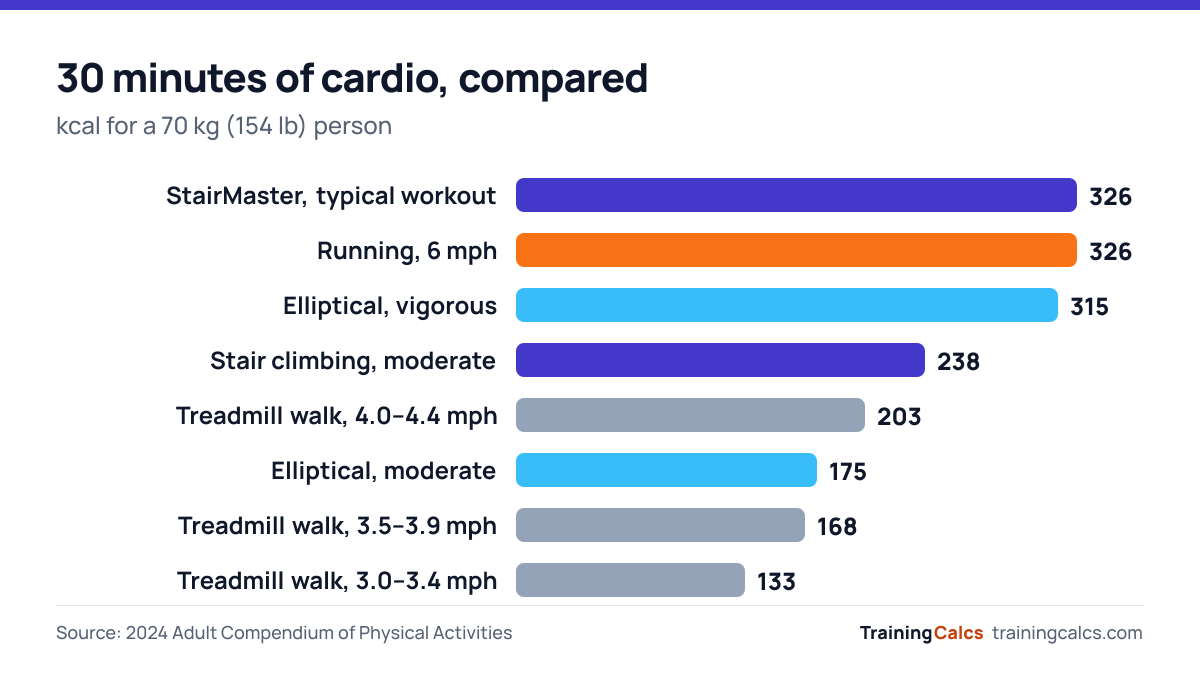
The StairMaster has a reputation as the hardest machine in the gym, and anyone who has done 20 minutes on one knows why. But does it really burn more than the treadmill, the elliptical or a run? Machine displays can’t settle the argument — they use different formulas and often guess your weight. Here is a like-for-like comparison using research-based values.
How we compare cardio machines
Researchers measure the energy cost of activities in METs (metabolic equivalents) — multiples of the energy you use sitting still. The 2024 Adult Compendium of Physical Activities, published by Herrmann and colleagues, lists average MET values for hundreds of activities, based on measurements in real people. Calories follow from a simple formula:
Calories = METs × body weight (kg) × hours
Because everything uses the same method, the comparison is fair — even if any single number is an average rather than your personal burn.
30 minutes, machine by machine
| Activity (Compendium code) | METs | 70 kg (154 lb) | 90 kg (198 lb) |
|---|---|---|---|
| StairMaster, typical workout (02065) | 9.3 | 326 kcal | 419 kcal |
| Stair climbing, moderate pace (17131) | 6.8 | 238 kcal | 306 kcal |
| Stair climbing, slow pace (17133) | 4.5 | 158 kcal | 203 kcal |
| Treadmill walk, 3.0–3.4 mph, flat (17350) | 3.8 | 133 kcal | 171 kcal |
| Treadmill walk, 3.5–3.9 mph, flat (17354) | 4.8 | 168 kcal | 216 kcal |
| Treadmill walk, 4.0–4.4 mph, flat (17358) | 5.8 | 203 kcal | 261 kcal |
| Running, 6–6.3 mph (10 min/mile) (12050) | 9.3 | 326 kcal | 419 kcal |
| Elliptical, moderate effort (02048) | 5.0 | 175 kcal | 225 kcal |
| Elliptical, vigorous effort (02049) | 9.0 | 315 kcal | 405 kcal |
StairMaster vs treadmill walking
A typical StairMaster session (9.3 METs) burns about twice as much as brisk walking on a flat treadmill at 3.5–3.9 mph (4.8 METs). For a 70 kg person, that is 326 kcal versus 168 kcal in 30 minutes. Even a fast 4.0–4.4 mph walk (5.8 METs) only reaches 203 kcal.
The reason is simple: on stairs you lift your whole body weight up with every step, while walking on the flat mostly moves you forward. Raising the treadmill incline closes the gap, because you start doing vertical work too.
StairMaster vs running
Running at 6–6.3 mph (a 10-minute mile) is also 9.3 METs, so minute for minute it matches a typical StairMaster workout. Faster running burns more; slower jogging burns less. The StairMaster’s advantage is impact: there is no landing phase, which many people find easier on their joints.
What about the elliptical?
The elliptical depends heavily on effort. At a vigorous effort (9.0 METs) it comes close to the StairMaster; at a moderate effort (5.0 METs) it burns only about half as much. Because the elliptical’s momentum can carry you, it’s easy to drift into an easier effort than you think.
Why body weight matters
Calories scale directly with body weight, because every step moves more mass. The chart shows 30-minute burns across body weights:
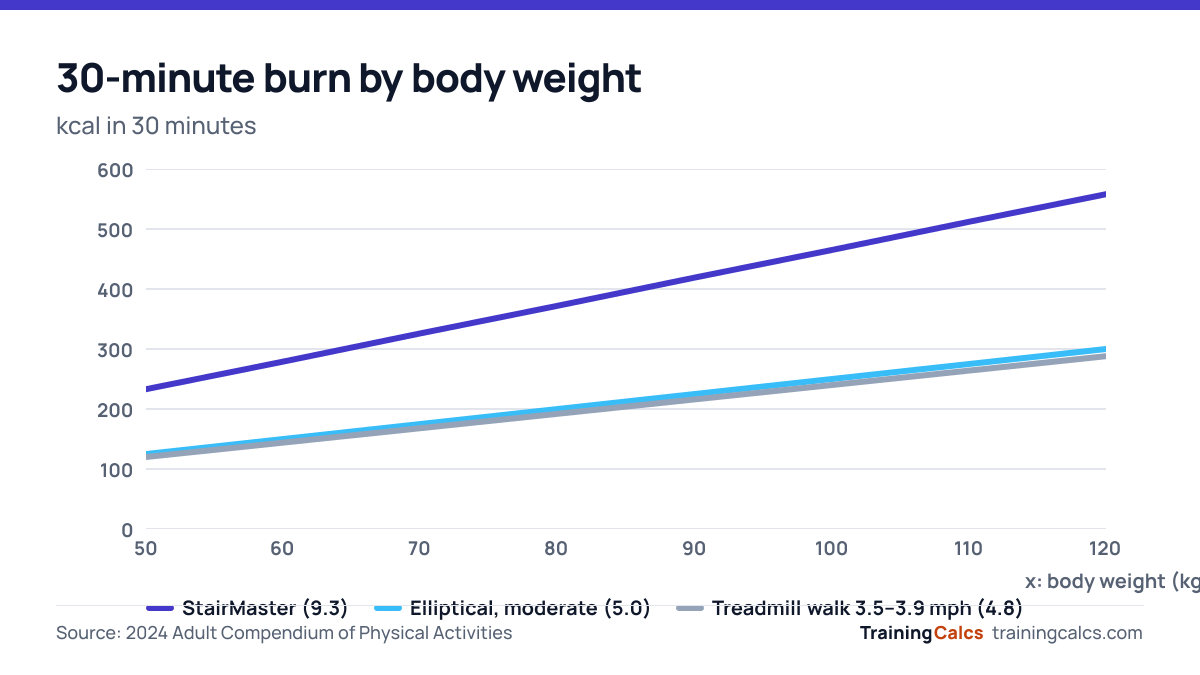
At 9.3 METs, a 100 kg person burns about 465 kcal in 30 minutes, while a 60 kg person burns about 279. The difference between machines also widens as body weight rises, which is why heavier people see bigger gains from choosing a harder machine. You can calculate your own numbers with the StairMaster calories calculator.
Beyond calories
- Muscles worked. Stair climbing loads the glutes, quads and calves more than flat walking.
- Impact. Stairs, elliptical and walking are low impact; running is not.
- Sustainability. Walking is the easiest to keep up for long periods; the StairMaster is intense, so sessions tend to be shorter.
- Carry-over. Stair climbing is excellent preparation for steep hikes.
Which should you choose?
Minute for minute, the stair climber and running are the most demanding options here. But the best machine is the one you will use consistently at a challenging effort. If the StairMaster is too hard at first, start with incline treadmill walking and build up. If you love running, there’s no need to switch. Mixing machines across the week is also a good way to spread the load on your joints.
Sample StairMaster workouts
| Workout | How to do it |
|---|---|
| Beginner steady | 10–15 minutes at a pace where you can talk in short sentences. |
| Intervals | 15–20 minutes alternating 1 minute fast and 1 minute easy. |
| Steady endurance | 30 minutes at a moderate, sustainable pace. |
| Hike prep | 30–45 minutes steady, optionally with a light backpack. |
- Stand tall and keep a light grip — leaning on the rails reduces the work.
- Place your whole foot on each step rather than climbing on your toes.
- Build up the time first, then the speed.
MET values are averages. Fitness, technique and how hard you push all change your real burn, and machine displays often differ from these estimates.
Try the StairMaster Calories CalculatorCalories burned on a stair climber for your weight, time and pace.Frequently asked questions
Is the StairMaster better than the treadmill for burning calories?
Compared with walking on a flat treadmill, yes — a typical StairMaster workout burns about twice as much per minute. Compared with running at about 6 mph, it is roughly the same. Incline treadmill walking sits in between.
How many calories does 30 minutes on the StairMaster burn?
About 279 kcal for a 60 kg (132 lb) person, 326 kcal at 70 kg (154 lb), 372 kcal at 80 kg (176 lb) and 465 kcal at 100 kg (220 lb), using 9.3 METs from the 2024 Compendium.
Why does the machine show a different number?
Machines often assume a default body weight, use their own formulas, or include the calories you would burn at rest anyway. Enter your weight if the machine allows it, and treat any display as an estimate.
Is the StairMaster bad for your knees?
Stair climbing is low impact compared with running, and many people with sore knees find it comfortable. If climbing causes pain, lower the speed, take shorter steps, and check with a physiotherapist.
Does holding the rails reduce calories burned?
Yes. Leaning on the rails supports some of your body weight, so your legs do less work. Use a light touch for balance and stand tall.
References
- Herrmann SD, Willis EA, Ainsworth BE, et al. 2024 Adult Compendium of Physical Activities: a third update of the energy costs of human activities. J Sport Health Sci. 2024;13(1):6–12. pubmed.ncbi.nlm.nih.gov/38242596/
- Compendium of Physical Activities — 2024 Adult Compendium activity codes and MET values. pacompendium.com/adult-compendium/
General fitness information, not medical advice. Figures are estimates calculated with the formulas cited above. Check with a doctor or qualified coach before major changes to diet, supplements or training. Read the full medical disclaimer and how we write and check these pages in our editorial policy.