Body composition
How to body recomp: lose fat and build muscle at the same time
The classic advice is to “bulk” to build muscle, then “cut” to lose the fat you gained on the way. Body recomposition skips the cycle: you lose fat and build muscle at the same time, while your scale weight barely moves. It’s real and well supported — but it works much better for some people than others, and it needs a slightly different approach from a standard diet. Here is how to body recomp, step by step.
How to body recomp in 3 steps: (1) eat at maintenance on training days and about 15% below on rest days, (2) eat 1.6–2.2 g of protein per kg of body weight every day, and (3) lift three to five times a week with progressive overload. Then track your waist and strength, not the scale.
What body recomposition is
Your body weight is made of fat mass and lean mass. A typical diet aims to reduce total weight, and some of what you lose is muscle. A typical bulk aims to add weight, and some of what you gain is fat. Recomposition aims to shift the ratio instead: less fat, more muscle, roughly the same total.
That’s possible because your body can draw on stored fat for energy while resistance training and a high protein intake give it both the signal and the raw material to build muscle.
Who can recomp?
A 2020 review by Barakat and colleagues in the Strength and Conditioning Journal concluded that recomposition is possible even in trained lifters, but it happens most readily in:
- Beginners, whose muscles respond quickly to any sensible training.
- People returning after a break — lost muscle tends to come back faster than it was first built.
- People with more body fat, who have plenty of stored energy to support muscle growth.
If you are already lean and have trained hard for years, a recomp will be slow. You may get better results from a focused period of muscle gain followed by a short fat-loss phase.
How to body recomp, step 1: set your calories
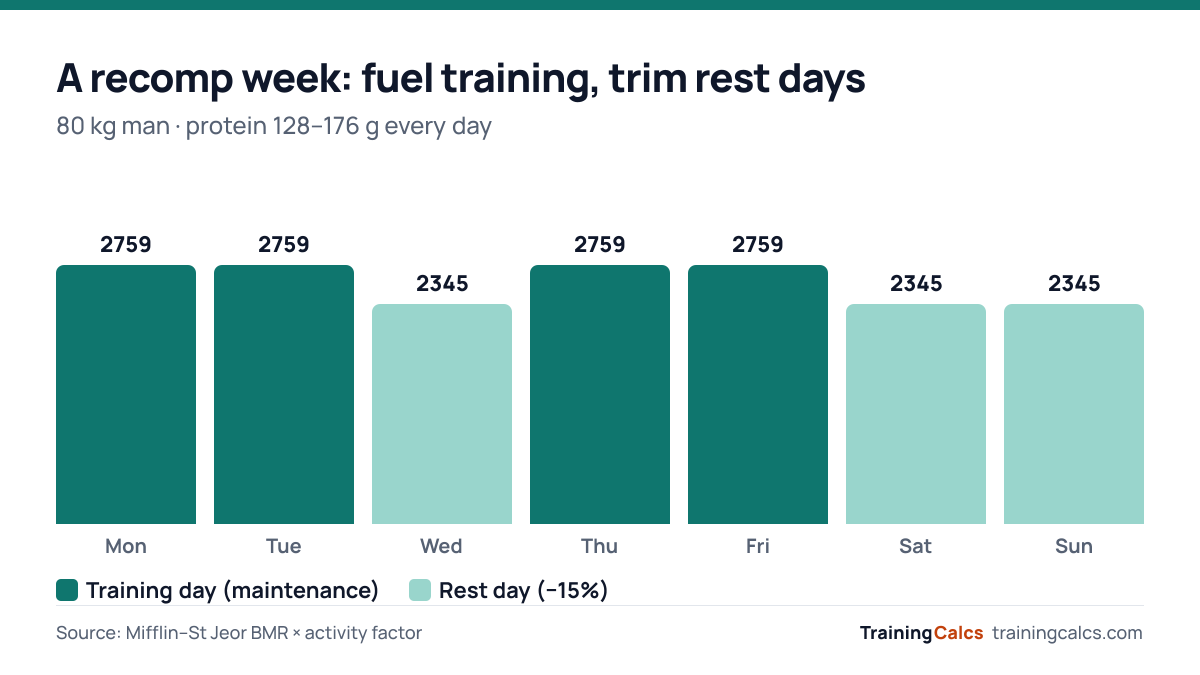
Recomp works at or slightly below maintenance — the number of calories that keeps your weight stable. A simple, effective approach is to cycle calories:
- Training days: eat at maintenance, so you have fuel to train hard and recover.
- Rest days: eat about 15% below maintenance.
Over a week, that creates a small deficit that chips away at fat without undermining your sessions. Here is what it looks like for two example people (age 30, moderately active):
| Example | Training days | Rest days | Protein | Fat (at least) |
|---|---|---|---|---|
| Man, 80 kg, 180 cm | 2759 kcal | 2345 kcal | 128–176 g | 77 g |
| Woman, 65 kg, 165 cm | 2124 kcal | 1805 kcal | 104–143 g | 59 g |
Maintenance here is estimated with the Mifflin–St Jeor equation, which predicts resting energy use from weight, height, age and sex, multiplied by an activity factor. Treat it as a starting point: weigh yourself most mornings and look at the weekly average. If it trends steadily down or up over 2–3 weeks, adjust by 100–200 kcal. The body recomposition calculator gives you these numbers for your own stats.
Step 2: prioritise protein
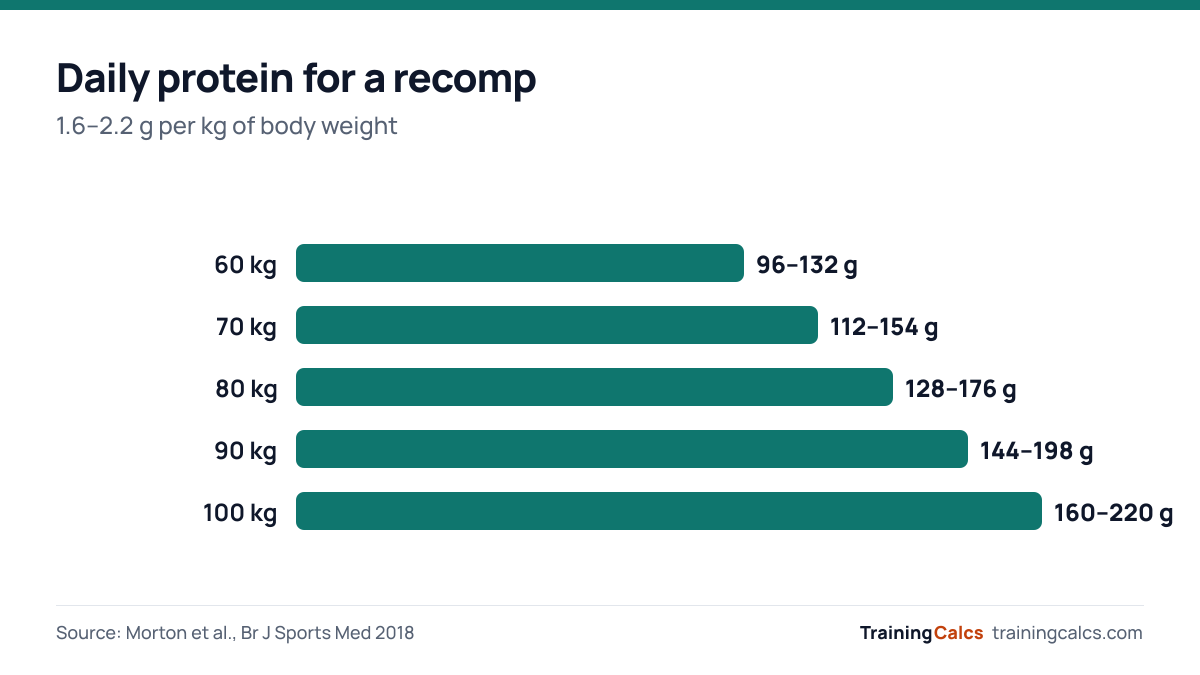
Protein is the non-negotiable part of a recomp. A 2018 meta-analysis by Morton and colleagues pooled 49 trials and found the benefit of extra protein for muscle gain levelled off around 1.6 g per kg of body weight a day, with some people benefiting up to about 2.2 g/kg. During a recomp, when you are also eating around maintenance, aiming for that range is sensible.
- Spread it across three or four meals, each with a solid protein source.
- Good sources include meat, fish, eggs, dairy and Greek yoghurt, tofu, tempeh, legumes and protein powder.
- Keep fat at a sensible minimum (around a quarter of your calories) and fill the rest with carbohydrates, especially around training.
Step 3: train for muscle
Resistance training is what tells your body to hold on to — and build — muscle while you lose fat. Without it, eating less mostly produces weight loss, including muscle.
- Lift three to five times a week, training each muscle group at least twice.
- Build around compound lifts — squats, hinges, presses, rows and pull-ups — and add isolation work for lagging areas.
- Use progressive overload: add weight or reps over time. If your lifts stall for weeks, recovery or calories may be too low.
- End most sets 1–3 reps short of failure.
Cardio, steps and sleep
Cardio is good for your health and adds to the deficit, but keep it from wrecking your lifting. Daily walking is an easy win: it burns energy without much fatigue. If you do hard conditioning, keep it away from heavy leg sessions.
Sleep matters more than most people think. Muscle is built during recovery, and short sleep makes both training and appetite control harder. Aim for 7–9 hours.
How to tell it’s working
Because fat loss and muscle gain cancel out on the scale, weight is a poor guide. Track these instead, every two to four weeks:
- Waist measurement at the navel, first thing in the morning.
- Progress photos in the same light, pose and time of day.
- Strength on your main lifts.
- How your clothes fit.
A shrinking waist with steady or rising strength is the signature of a successful recomp. A body-fat scale can add context, but its day-to-day readings are noisy, so only trust the long-term trend.
How long does a recomp take?
Expect visible changes in 8–12 weeks and meaningful ones over 6–12 months. Beginners often see faster results in the first few months; experienced lifters should expect slower, steadier progress. Consistency — hitting protein and training most weeks — matters far more than any single perfect day.
Common recomp mistakes
- Cutting calories too hard. A big deficit makes muscle gain very difficult and turns a recomp into a regular diet.
- Skimping on protein. Hitting 1.6 g/kg most days is the difference between building muscle and just losing weight.
- Judging by the scale. A flat scale weight is normal. Use the tape and photos.
- Program hopping. Stick with one well-structured program long enough to progress on it.
Recomp, bulk or cut?
If you are new to lifting, returning after time off, or carrying more body fat than you would like, a recomp is often the most enjoyable path: you never have to “get fat to get big”. If you are already lean and experienced, alternating dedicated muscle-gain and fat-loss phases usually works better. Either way, the fundamentals are the same: train hard, eat enough protein, and give it time.
Try the Body Recomposition CalculatorCalories and protein to lose fat while building muscle.Frequently asked questions
Is body recomposition real?
Yes. A 2020 review by Barakat and colleagues concluded that people can gain muscle while losing fat at the same time, including trained lifters, although it happens most readily in beginners, people returning from a break and people with more body fat.
Should I eat in a deficit to recomp?
A small deficit or maintenance works best. Eating at maintenance on training days and about 15% below on rest days creates a modest weekly deficit without undermining training. Large deficits make muscle gain much harder.
How much protein do I need for a recomp?
Aim for 1.6–2.2 g per kg of body weight every day. For an 80 kg person that is about 128–176 g, spread over three or four meals.
Why isn’t my weight changing during a recomp?
That is expected. If you lose fat and gain muscle at similar rates, the scale barely moves. A shrinking waist and rising strength are the signs it is working.
Can I recomp without lifting weights?
Not effectively. Resistance training is the signal that tells your body to build muscle while you lose fat. Without it, a calorie deficit mostly produces weight loss, including some muscle.
References
- Barakat C, Pearson J, Escalante G, Campbell B, De Souza EO. Body recomposition: can trained individuals build muscle and lose fat at the same time? Strength Cond J. 2020;42(5):7–21. doi.org/10.1519/SSC.0000000000000584
- Morton RW, Murphy KT, McKellar SR, et al. A systematic review, meta-analysis and meta-regression of the effect of protein supplementation on resistance training-induced gains in muscle mass and strength in healthy adults. Br J Sports Med. 2018;52(6):376–384. pubmed.ncbi.nlm.nih.gov/28698222/
- Mifflin MD, St Jeor ST, Hill LA, et al. A new predictive equation for resting energy expenditure in healthy individuals. Am J Clin Nutr. 1990;51(2):241–247. pubmed.ncbi.nlm.nih.gov/2305711/
General fitness information, not medical advice. Figures are estimates calculated with the formulas cited above. Check with a doctor or qualified coach before major changes to diet, supplements or training.