Strength
What is a good DOTS score? Percentiles from real meet results
DOTS turns your powerlifting total into one number adjusted for body weight — but what number counts as good? There is no official scale, so we went to the source: the OpenPowerlifting database of competition results. We took the best-ever DOTS of every lifter who completed a full meet and worked out where each score ranks. Here is what we found.
The short answer
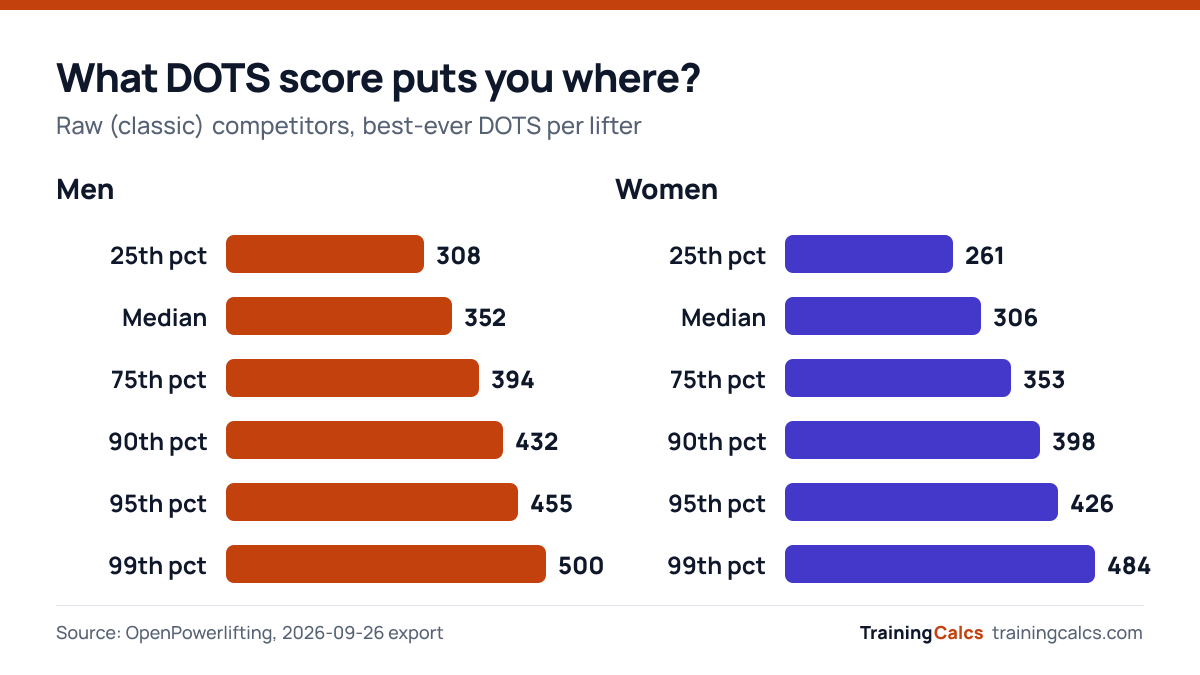
Among raw (classic) competitors, a DOTS of about 352 for men or 306 for women is the median — better than half of everyone who has competed. 432 (men) or 398 (women) is top 10%, and 500 (men) or 484 (women) is top 1%.
DOTS percentiles: raw lifters
Each lifter is counted once, at their best-ever DOTS. The table shows the score needed to reach each percentile among 285,060 men and 132,840 women who have competed raw:
| Percentile | Men (raw) | Women (raw) |
|---|---|---|
| 10th | 262 | 222 |
| 25th | 308 | 261 |
| 50th (median) | 352 | 306 |
| 75th | 394 | 353 |
| 90th | 432 | 398 |
| 95th | 455 | 426 |
| 99th | 500 | 484 |
What your score means
Flip it around: what share of raw competitors have ever reached each score?
| DOTS | Men who reached it | Women who reached it |
|---|---|---|
| 200 | 98% | 95% |
| 250 | 92% | 80% |
| 300 | 79% | 54% |
| 350 | 51% | 26% |
| 400 | 22% | 10% |
| 450 | 6% | 3% |
| 500 | 1% | 1% |
So a 400 DOTS puts you ahead of about 78% of raw men and 91% of raw women who have competed, and 500 is reached by only about 1%. Work out your own score with the DOTS calculator.
Equipped lifters
Equipped lifting uses supportive suits and shirts, which let lifters handle more weight. The spread of equipped scores is wider — the top end is higher than raw, while the median is similar:
| Percentile | Men (equipped) | Women (equipped) |
|---|---|---|
| 10th | 249 | 213 |
| 25th | 293 | 252 |
| 50th (median) | 348 | 302 |
| 75th | 409 | 363 |
| 90th | 465 | 424 |
| 95th | 496 | 466 |
| 99th | 558 | 554 |
Equipped here means single-ply or multi-ply. Compare equipped scores only with equipped lifters.
Drug-tested lifters
Most raw competitors in the database compete in drug-tested federations or divisions: 238,264 of the men and 112,878 of the women. Their percentiles are almost identical to the full raw figures:
| Percentile | Men (raw, tested) | Women (raw, tested) |
|---|---|---|
| 10th | 261 | 222 |
| 25th | 307 | 262 |
| 50th (median) | 351 | 307 |
| 75th | 392 | 354 |
| 90th | 428 | 397 |
| 95th | 451 | 425 |
| 99th | 493 | 478 |
How these numbers were calculated
- Data: the OpenPowerlifting bulk export, 2026-09-26, which covers meets from many federations worldwide. OpenPowerlifting’s data is in the public domain.
- Entries: full-power meets only (squat, bench press and deadlift), with a valid placing — disqualified, no-show and guest entries were excluded. That left 2,188,757 entries.
- One number per lifter: each lifter’s best-ever DOTS, so people who compete often don’t count more than once.
- Formula check: our DOTS calculator matched OpenPowerlifting’s own DOTS values exactly on a random sample of 399 results.
Limitations: the database only includes people who entered a meet, so these percentiles describe competitors, not everyone who lifts. Federations and eras differ, and a lifter’s best-ever score may come from years ago. Restricting to meets since 2016 changes the raw percentiles by only a few points.
DOTS vs Wilks vs IPF GL
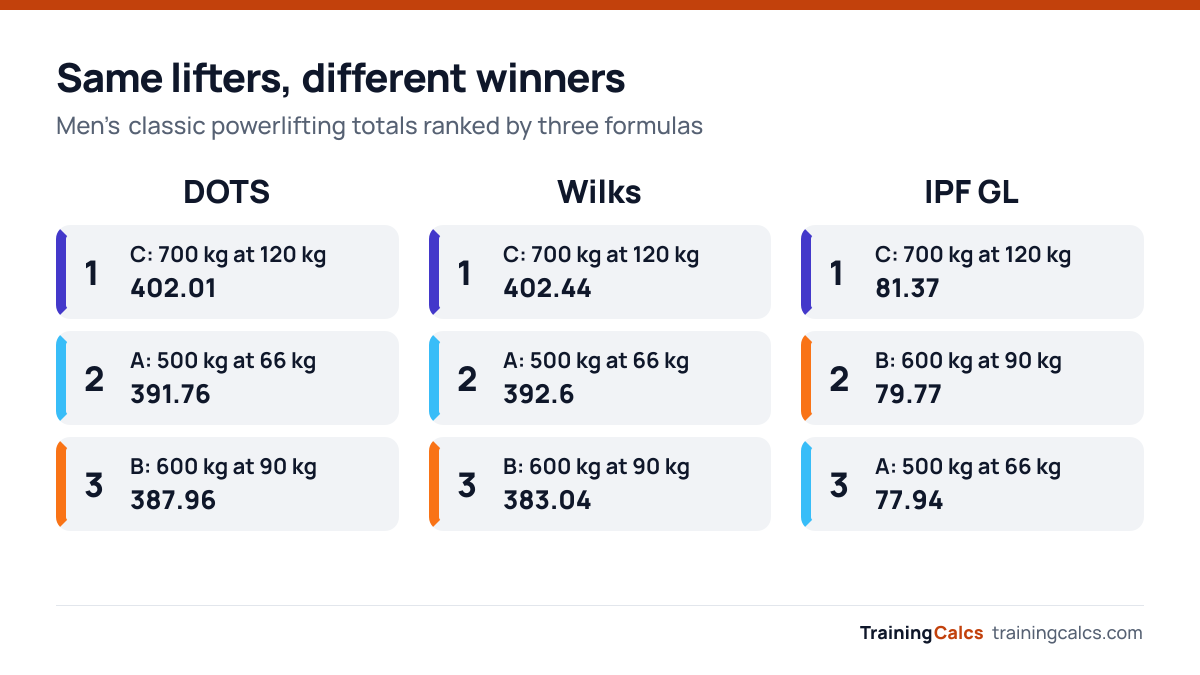
DOTS isn’t the only body-weight formula. Wilks was the standard for decades, and the IPF uses its own GL points. For most lifters, DOTS and original Wilks are close — 600 kg at 90 kg is 387.96 DOTS and 383.04 Wilks — while IPF GL uses a much smaller scale (79.77 points). Close contests can even flip depending on the formula:
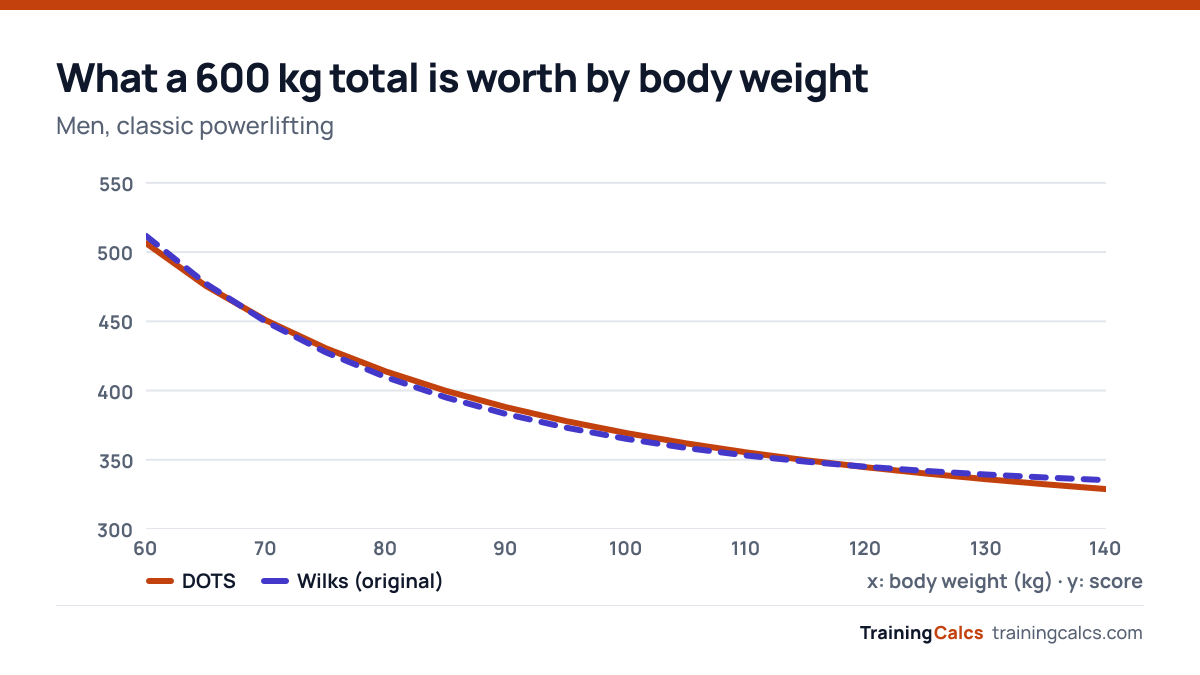
The same total is worth far more at a light body weight than a heavy one, and DOTS and Wilks track each other closely through the middle of the range:
Only compare scores from the same formula. The Wilks calculator and powerlifting score calculator show the other scores.
How to raise your DOTS
- Add to your total. For a 90 kg man, every extra 10 kg on the total adds about 6.5 DOTS points.
- Build muscle, not just body weight. DOTS rewards strength relative to body weight, so gaining fat without gaining strength lowers your score.
- Get meet-ready. Good attempt selection, a peak before the meet and making weight comfortably often add more to a score than months of extra training.
- Track it over time. Your DOTS is most useful as a measure of your own progress across different body weights.
Frequently asked questions
What is a good DOTS score?
Among raw competitive lifters, a DOTS above about 352 (men) or 306 (women) is better than half of everyone who has competed; around 432 (men) or 398 (women) puts you in the top 10%, and about 500 (men) or 484 (women) in the top 1%.
Is a DOTS of 300 good?
For a first meet, it’s a solid start. Among raw competitors, 300 beats about 22% of men and 47% of women based on their best-ever scores — and most competitors have trained for years.
Is a DOTS of 400 good?
Yes. A 400 DOTS beats about 78% of raw men and 91% of raw women in the OpenPowerlifting database.
Why are women’s percentiles lower if DOTS is sex-adjusted?
DOTS uses separate coefficients for men and women, but the distributions of competitors still differ. Comparing within your own sex, as these tables do, gives the most meaningful picture.
Do these numbers apply to gym lifters?
Not directly. They describe people who have competed, who tend to be stronger than the average gym-goer. If you have never competed, a lower DOTS can still be a very respectable result.
References
- OpenPowerlifting — this page uses data from the OpenPowerlifting project (bulk export of 2026-09-26). You may download a copy of the data at data.openpowerlifting.org. www.openpowerlifting.org/
- OpenPowerlifting data service — bulk CSV downloads and documentation. openpowerlifting.gitlab.io/opl-csv/
- International Powerlifting Federation. IPF GL Coefficients (2020). www.powerlifting.sport/fileadmin/ipf/data/ipf-formula/IPF_GL_Coefficients-2020.pdf
General fitness information, not medical advice. Figures are estimates calculated with the formulas cited above. Check with a doctor or qualified coach before major changes to diet, supplements or training.