Strength
How much does a barbell weigh? Bar weights, plates and loading
A standard men’s Olympic barbell weighs 20 kg (44.1 lb), a women’s Olympic barbell weighs 15 kg (33.1 lb), and most barbells in US gyms weigh 45 lb (20.4 kg). Specialty bars — EZ curl, trap and Smith machine bars — vary a lot. Knowing exactly what your bar weighs matters: a 5 kg mistake in the bar is a 5 kg mistake in every set you log. This guide covers every common bar, then shows how to load it, with full plate charts in kg and lb.
How much does a barbell weigh?
| Bar | Weight | Notes |
|---|---|---|
| Men’s Olympic bar | 20 kg (44.1 lb) | Standard in most gyms and competitions |
| Women’s Olympic bar | 15 kg (33.1 lb) | Thinner grip, slightly shorter |
| US standard bar | 45 lb (20.4 kg) | The usual bar in pound-based gyms |
| Technique bar | Often 5–15 kg | Varies a lot — check the label |
| EZ curl bar | Often 7–12 kg | Varies by brand — check the label |
| Trap or hex bar | Often 20–30 kg | Varies by brand — check the label |
| Smith machine bar | Varies widely | Often counterbalanced — check the machine |
If a bar isn’t marked, don’t guess from its size. Many gyms list their bar weights on the wall or the rack, and manufacturers publish them online.
Olympic bars: men’s and women’s
The bars used in weightlifting and powerlifting competitions are called Olympic bars. The men’s bar weighs 20 kg and has a 28 mm grip. The women’s bar weighs 15 kg, is slightly shorter, and has a thinner 25 mm grip that suits smaller hands. Both have rotating sleeves that take standard Olympic plates with a 50 mm hole.
Anyone can use either bar. Many lifters with smaller hands prefer the 15 kg bar for Olympic lifts, while most powerlifting and general gym training uses the 20 kg bar.
Standard, EZ, trap and Smith machine bars
- US standard bars (45 lb). Most commercial gyms in the US use 45 lb (20.4 kg) bars — very close to, but not the same as, a 20 kg Olympic bar.
- EZ curl bars. The zig-zag shape eases wrist strain on curls and extensions. They are much lighter than straight bars and vary by brand.
- Trap (hex) bars. You stand inside the frame for deadlifts and carries. They are usually heavier than a standard bar, and weights vary a lot between models.
- Smith machine bars. The bar runs on rails, and many machines use counterweights so the bar feels lighter than it is. There’s no standard — check the label and log the same way every time.
- Fixed-weight bars. Pre-loaded bars in racks show their total weight on the ends; there’s nothing to add.
Do you count the bar?
Yes. The convention is to count everything you lift: bar plus plates (plus collars, if they are heavy). A 45 lb bar with one 45 lb plate on each side is a 135 lb lift, not 90 lb. When you follow a program or compare lifts with anyone else, always include the bar.
The plates-per-side formula
Weight per side = (target − bar − collars) ÷ 2
Then build that weight from the heaviest plates down:
- Subtract the bar (and collars, if you use them) from your target.
- Divide what’s left by two.
- Take the biggest plate that fits, subtract it, and repeat with what remains.
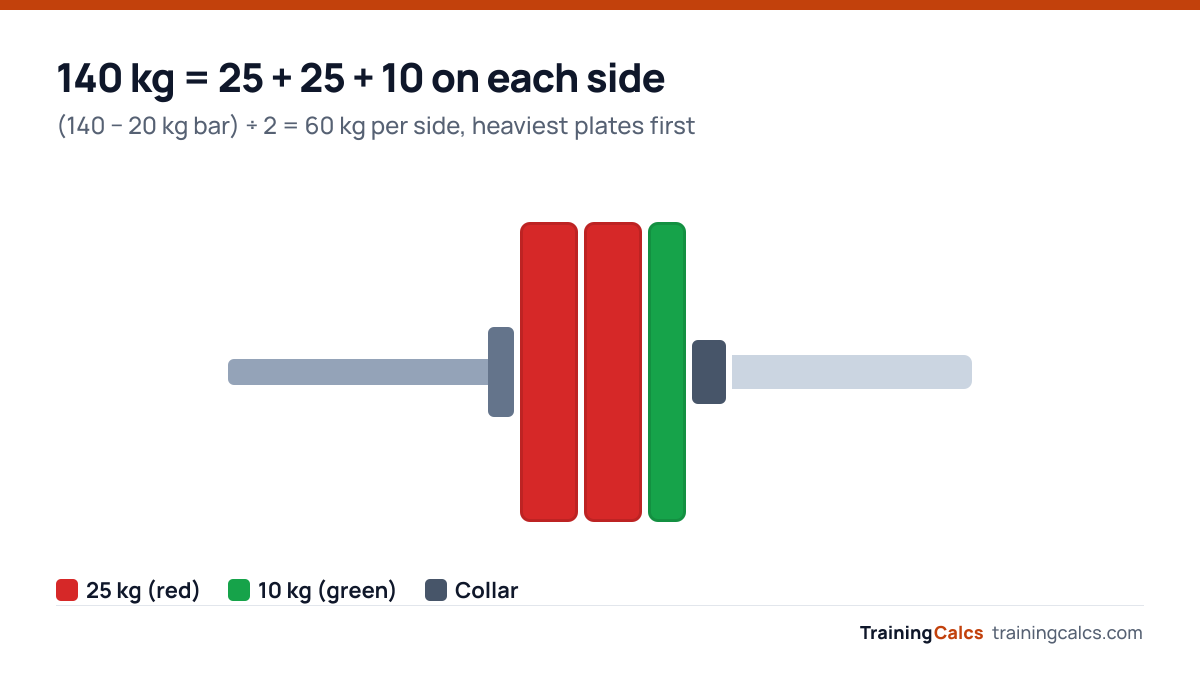
For 140 kg on a 20 kg bar: (140 − 20) ÷ 2 = 60 kg per side. The biggest plate that fits is 25 kg, leaving 35; another 25 leaves 10; a 10 kg plate finishes it. So each side gets 25 + 25 + 10.
Kilogram loading chart (20 kg bar)
With a standard kilogram plate set and no collars:
| Target | Per side | Plates per side |
|---|---|---|
| 60 kg | 20 kg | 20 |
| 80 kg | 30 kg | 25 + 5 |
| 100 kg | 40 kg | 25 + 15 |
| 120 kg | 50 kg | 25 + 25 |
| 140 kg | 60 kg | 25 + 25 + 10 |
| 160 kg | 70 kg | 25 + 25 + 20 |
| 180 kg | 80 kg | 25 + 25 + 25 + 5 |
| 200 kg | 90 kg | 25 + 25 + 25 + 15 |
Pound loading chart (45 lb bar)
In pound gyms the classic milestones are easy to remember because 45 lb plates stack neatly on a 45 lb bar: 135 is one plate a side, 225 is two, 315 is three and 405 is four.
| Target | Per side | Plates per side |
|---|---|---|
| 95 lb | 25 lb | 25 |
| 135 lb | 45 lb | 45 |
| 185 lb | 70 lb | 45 + 25 |
| 225 lb | 90 lb | 45 + 45 |
| 275 lb | 115 lb | 45 + 45 + 25 |
| 315 lb | 135 lb | 45 + 45 + 45 |
| 405 lb | 180 lb | 45 + 45 + 45 + 45 |
To skip the arithmetic altogether, the plate calculator works out any target in kg or lb, for any bar, with or without collars, and draws the loaded bar for you.
Plate colors
Competition plates follow a color code so judges and lifters can read the bar at a glance: 25 kg red, 20 kg blue, 15 kg yellow and 10 kg green. Smaller change plates vary between federations and brands.
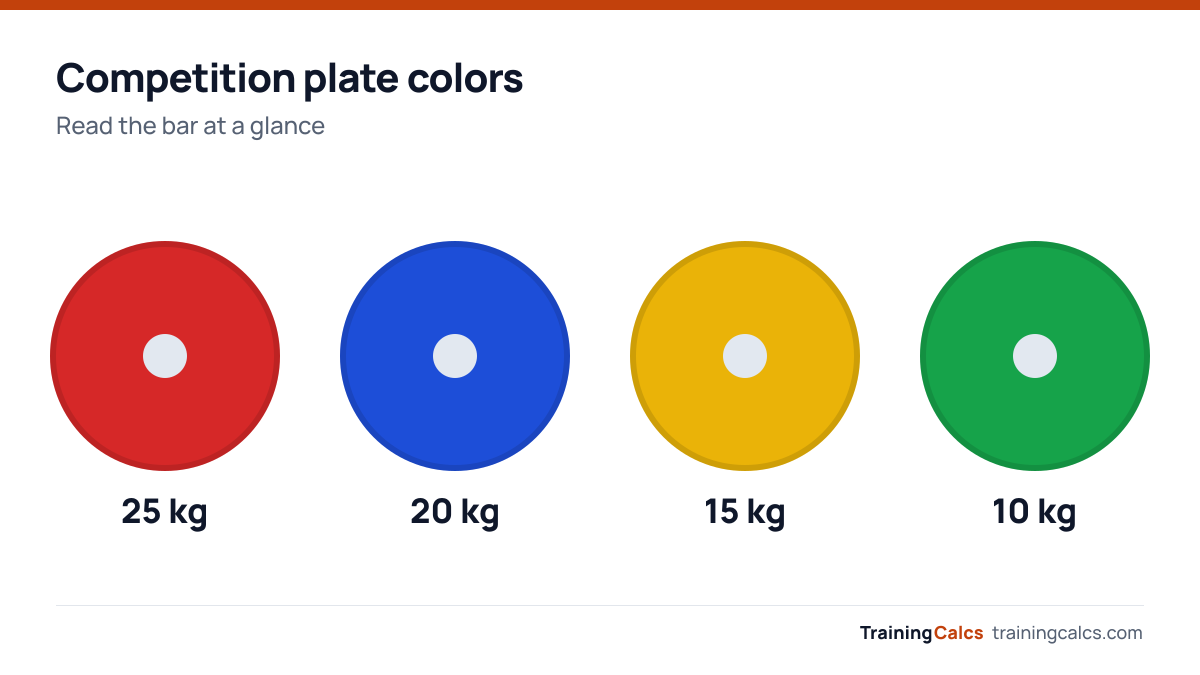
Many commercial gyms use plain black or grey plates, and some colored bumper plates use different color schemes for pound weights. Always read the number on the plate rather than trusting the color.
Collars and clips
Spring clips and plastic lock-jaw collars weigh very little, and most people leave them out of the maths. Competition collars are different: they weigh 2.5 kg each, 5 kg for the pair. If you train with them, include them — otherwise your 200 kg deadlift is really 205 kg.
Collars are worth using for anything heavy. Plates that slide during a squat or bench press shift the load to one side at exactly the wrong moment.
Mixing kilograms and pounds
One kilogram is about 2.2046 lb. A 20 kg plate is 44.1 lb, not 45, and a 45 lb plate is 20.4 kg, not 20. The difference is small for one plate but adds up quickly:
- A 20 kg bar with two 20 kg plates is 60 kg, or 132.3 lb — not the 135 lb you might assume.
- Four 20 kg plates on a 20 kg bar is 100 kg, or 220.5 lb — not 225 lb.
- Four 45 lb plates on a 45 lb bar is 225 lb, or 102.1 kg — not 100 kg.
When a gym mixes plate types, convert everything to one unit before you load, and log the unit you actually used.
When the plates don’t add up
Each side can only change in steps of your smallest plate, so the whole bar moves in steps of twice that. With 1.25 kg as your smallest plate, you can load in 2.5 kg jumps; with 2.5 lb plates, 5 lb jumps. If your program asks for 102 kg, load 102.5 kg (or 100 kg) and write down what you actually lifted.
Fractional plates, such as 0.5 kg or 1 lb, let you make smaller jumps — useful for pressing movements where 2.5 kg is a big step.
Loading safely
- Put the heaviest plates on first, closest to the middle, so the load is stable.
- Load and unload one plate per side at a time. Stripping one side completely can flip the bar off the rack.
- Push plates all the way against the collar or inner sleeve.
- Use collars for anything heavy, and for all overhead and bench work.
- Double-check both sides match before you lift — mismatched sides are a common error.
Frequently asked questions
How much does a barbell weigh?
A standard men’s Olympic barbell weighs 20 kg (44.1 lb) and a women’s Olympic barbell 15 kg (33.1 lb). Most barbells in US gyms are 45 lb (20.4 kg). Technique, EZ, trap and specialty bars vary, so check the label.
How much does a Smith machine bar weigh?
It varies a lot between machines. Many are counterbalanced so the bar feels much lighter than its actual weight, and some are not. Check the label on the machine or the manufacturer’s specifications, and log the same way every time.
Do you count the bar when saying how much you lift?
Yes. The convention is to count the bar plus the plates, so a 45 lb bar with a 45 lb plate on each side is a 135 lb lift.
How do I work out plates per side?
Subtract the bar and any collars from your target and divide by two. For 100 kg on a 20 kg bar: (100 − 20) ÷ 2 = 40 kg per side, which is a 25 kg plate plus a 15 kg plate.
What is two plates on the bar?
In pound gyms, “two plates” means two 45 lb plates on each side of a 45 lb bar, which is 225 lb. With 20 kg plates on a 20 kg bar it is 100 kg, or about 220 lb.
References
- International Powerlifting Federation. Technical Rules Book (equipment specifications for bars, discs and collars). www.powerlifting.sport/rules/codes/info/technical-rules
General fitness information, not medical advice. Figures are estimates calculated with the formulas cited above. Check with a doctor or qualified coach before major changes to diet, supplements or training.