Nutrition
Creatine loading phase: is it necessary?

Creatine monohydrate is one of the best-researched supplements for strength, power and muscle. The label on the tub usually tells you to start with a “loading phase” of around 20 g a day. But is that necessary, or just a way to get through the tub faster? The research gives a clear answer — and it depends mainly on how quickly you want results.
How creatine works
Your muscles store creatine, mostly as phosphocreatine, which they use to regenerate energy very quickly during short, hard efforts like heavy sets and sprints. Diet and your body’s own production keep those stores partly full. Supplementing tops them up — the ISSN position stand notes increases in muscle creatine of roughly 20–40% — which lets you squeeze out a little more work in hard sets and supports training adaptations over time.
The key point: the benefits appear once your stores are full, not from any single dose. That’s why the question of loading is really a question of how fast you fill them.
What loading actually does
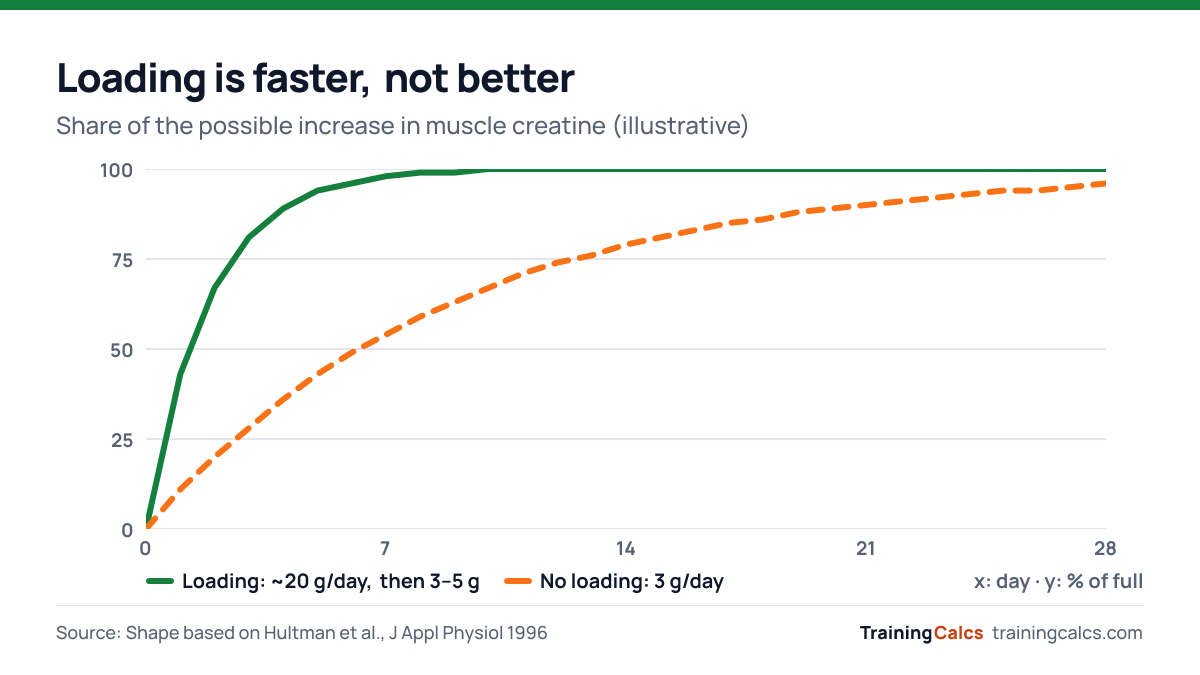
Loading is simply a faster way to fill your stores. A classic study by Hultman and colleagues (1996) showed this clearly: taking 20 g a day for six days raised muscle creatine quickly, while taking 3 g a day reached a similar level after about four weeks. Once stores were full, a small daily dose kept them there.
The chart at the top of this article shows the shape of those two paths. Loading gets you there in about a week; the slow route catches up by about week four.
What the guidelines recommend
The International Society of Sports Nutrition (ISSN) position stand (Kreider et al., 2017) describes both approaches:
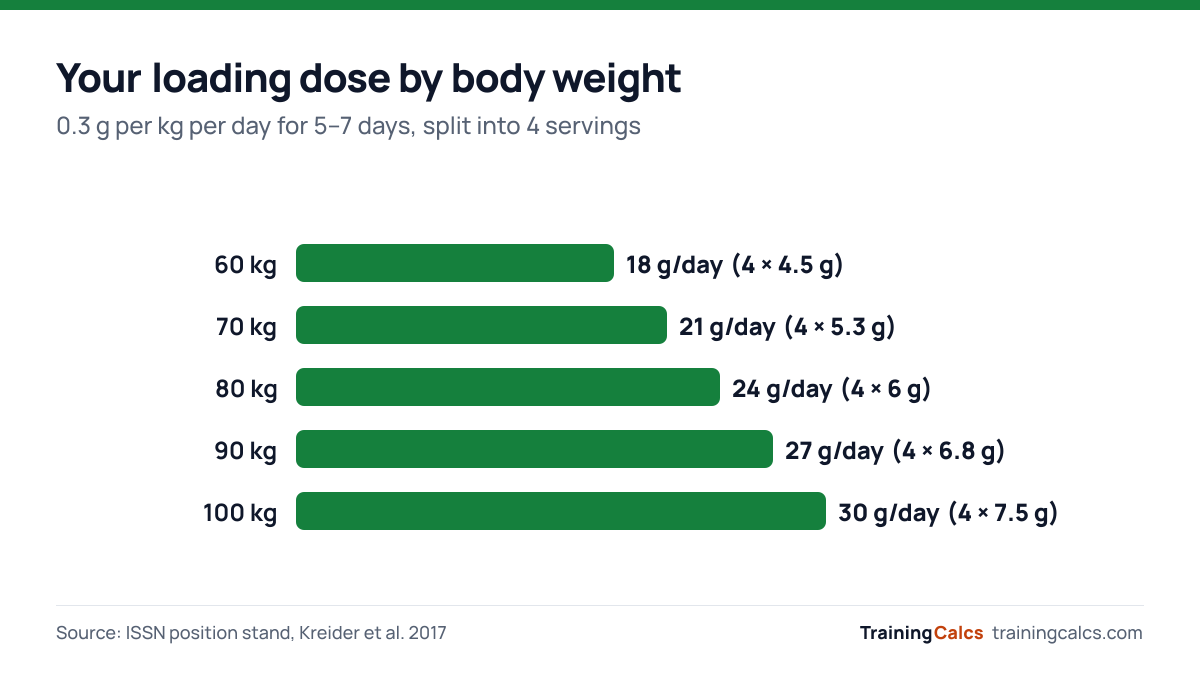
- With loading: about 0.3 g per kg of body weight a day, split into about four doses, for 5–7 days, then 3–5 g a day to keep stores full.
- Without loading: 3–5 g a day from the start, which increases muscle creatine over about 3–4 weeks.
- Larger athletes in intense training may need 5–10 g a day to keep their stores full.
Loading dose = 0.3 g × body weight (kg) per day, for 5–7 days
Maintenance = 3–5 g per day
Loading dose by body weight
| Body weight | Loading per day | Split into | Then daily |
|---|---|---|---|
| 60 kg (132 lb) | 18 g | 4 × 4.5 g | 3–5 g |
| 70 kg (154 lb) | 21 g | 4 × 5.3 g | 3–5 g |
| 80 kg (176 lb) | 24 g | 4 × 6 g | 3–5 g |
| 90 kg (198 lb) | 27 g | 4 × 6.8 g | 3–5 g |
| 100 kg (220 lb) | 30 g | 4 × 7.5 g | 3–5 g |
| 110 kg (243 lb) | 33 g | 4 × 8.3 g | 3–5 g |
The creatine calculator works out your loading and maintenance doses in kg or lb, with or without a loading phase.
So, is loading necessary?
No. You end up in the same place either way. Loading is worth it if you want the benefits within a week — for example at the start of a training block or before a competition. If you’re in no hurry, 3–5 g a day is simpler, cheaper and gentler on your stomach.
| Loading | No loading | |
|---|---|---|
| Daily dose | ~0.3 g/kg for 5–7 days, then 3–5 g | 3–5 g from day one |
| Stores full in | About 1 week | About 3–4 weeks |
| Stomach upset | More likely | Rare |
| End result | Same | Same |
How to load without stomach upset
- Split the daily amount into four servings spread through the day.
- Mix each serving in plenty of liquid, or take it with food.
- Drink normally; there’s no need to force extra water.
- Switch to your daily dose after 5–7 days. Longer loading doesn’t add anything.
- If loading upsets your stomach, simply stop and take 3–5 g a day instead.
Timing and what to take it with
Timing matters much less than taking it every day, including rest days. The ISSN notes that taking creatine with carbohydrate, or carbohydrate and protein, has been reported to improve creatine retention, so a meal or a post-workout shake is a convenient time. Pick whatever time you’ll remember.
What to expect on the scale
Most people gain some weight in the first week or two, largely water drawn into muscle along with the creatine. It isn’t fat, and it’s a sign the supplement is being absorbed. People who start with lower creatine stores — often vegetarians and vegans, who get little creatine from food — tend to see larger increases in muscle creatine.
Safety
The ISSN position stand concluded that creatine monohydrate is safe and well tolerated in healthy people at recommended doses, including in studies lasting several years, with no clinically significant side effects. Claims that it causes dehydration, cramping or kidney damage in healthy people haven’t held up in research.
If you have kidney disease, are pregnant or breastfeeding, are under 18, or take regular medication, speak to a doctor before using creatine.
Try the Creatine CalculatorYour loading and daily maintenance dose of creatine monohydrate.Frequently asked questions
Do I need to load creatine?
No. Loading fills your muscles in about a week; 3–5 g a day reaches the same level in about 3–4 weeks. Once your stores are full, both approaches give the same result.
How much creatine should I take during loading?
The ISSN describes about 0.3 g per kg of body weight a day — roughly 20 g for many people — split into four doses, for 5–7 days. For an 80 kg person that is 24 g a day, or 4 servings of 6 g.
What happens if I stop taking creatine?
Your muscle creatine gradually returns to its normal level over several weeks. You don’t need to cycle creatine; many people take it continuously.
Will creatine make me gain weight?
Most people gain some weight in the first week or two, largely water drawn into muscle along with the creatine. Over longer periods, any extra gain reflects the additional training and muscle it supports.
Which type of creatine is best?
Creatine monohydrate. It has by far the most research behind it, and the ISSN position stand is based mainly on it. Other forms haven’t been shown to work better.
References
- Kreider RB, Kalman DS, Antonio J, et al. International Society of Sports Nutrition position stand: safety and efficacy of creatine supplementation in exercise, sport, and medicine. J Int Soc Sports Nutr. 2017;14:18. pubmed.ncbi.nlm.nih.gov/28615996/
- Hultman E, Söderlund K, Timmons JA, Cederblad G, Greenhaff PL. Muscle creatine loading in men. J Appl Physiol. 1996;81(1):232–237. pubmed.ncbi.nlm.nih.gov/8828669/
General fitness information, not medical advice. Figures are estimates calculated with the formulas cited above. Check with a doctor or qualified coach before major changes to diet, supplements or training. Read the full medical disclaimer and how we write and check these pages in our editorial policy.